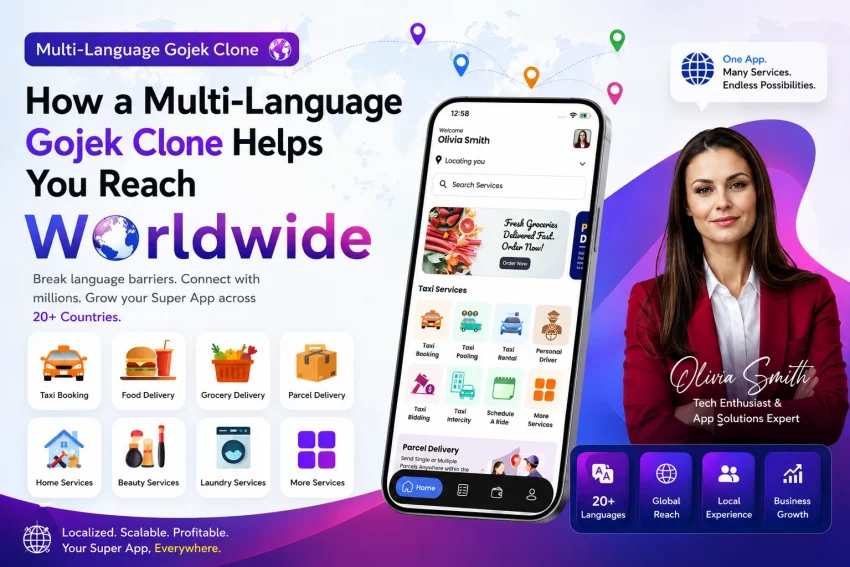
Many different business founders have their own ideas or approaches when it comes to adding new languages, and almost all of them naturally assume that it is just a minor feature to handle after the launch.
They are not wrong. See, a ready-made super app is a perfect way to start a business as it already has the built-in structural capability to support multiple languages and currencies. But success is not guaranteed in converting users across a new country, and it’s because of many ever-changing reasons.
For instance, many founders underestimate local user trust and its influence, i.e., the friction involved when people open the app and find it speaking a completely foreign language. There are many brilliant startups with beautifully customized apps offering multi-services, but they are left to wonder why they fail to convert their first thousand users.
In reality, setting up this local infrastructure actually requires a very critical and prepared mindset, as you are not dealing with a simple standalone product where language is just an optional afterthought.
How to Make Multi-Language Actually Work Across Your Entire Platform
To make the multi-language feature work really well, you need to set it up carefully for each country across every single app and panel in the system.
1. Choose Languages for Your Providers, Not Just Your Customers
The most common mistake when expanding a Gojek clone is choosing languages only based on what your end users speak, without thinking about the language your service providers use.
In many countries, there is a big difference between the language of educated city customers and the language that local service providers are actually comfortable with. For example, a delivery rider in Nairobi might mostly speak Swahili, while a home cleaner in Manila will feel much more confident working in Tagalog or Cebuano instead of English.
Your app might have up to 50 different service categories, and every single provider in those categories has to use the provider app to accept jobs, find users, and see their earnings.
If the app is in a language that is hard for your providers to understand, they won’t accept jobs, your service quality will go down, and you will see a lot of canceled or missed trips on your admin panel.
So, you must choose languages for both the customers and the providers at the same time.
Make sure to confirm during the setup process which language goes on which app, because the provider-side and customer-side language settings might need to be set up separately, rather than just assuming one setting works for everything.
2. Setting Up Currencies Based on Real Payment Habits
Usually, a standard Gojek clone works with all the popular payment systems in a region, so users can pay with cash, cards, and wallets. A professional app development firm will also let you set up different local currencies along with US dollars.
This is a great feature to have, but setting up a currency display and actually integrating a payment gateway are two completely different things. Confusing them can cause a big problem for your business plan.
If you are a founder planning to expand to multiple countries, you need to clearly discuss both the display currencies and the actual local payment gateways you want to use before you buy the software. You don’t want to find out about compatibility issues after the setup work has already started.
3. Localizing Your Notifications and Alerts
In-app notifications are standard features that let you send alerts about offers and events to users. All your notification messages, promo codes, and in-app banner texts must be in the same language the user chose when they signed up.
Many Clone app development firms will give you a system with language features built in, and the admin panel will have a screen to manage banner ads. But it is up to you as the operator, not the technology itself, to make sure the banners and notification texts actually match the user’s selected language.
So, you should plan your local content setup well before you launch, and not wait until after your first notifications cause confusion among users.
4. Using One App to Dominate Multiple Markets
Having one single app that supports multiple languages is a big advantage over local competitors who have only built their apps for one language and one market. In contrast, your Gojek clone enters a new country with all its services already prepared for different languages, currencies, payment gateways, and local service mixes.
You do not need to rebuild the technology for every new country. Only your current business operations and finding service providers will change in each market.
5. Planning Your Expansion with Annual Upgrades
When you are expanding to multiple countries, these annual upgrades are a great opportunity to add more languages and currencies as your business grows, instead of dealing with them as expensive, last-minute custom work.
This means you should have a clear language and currency plan before you even launch, instead of just reacting as you expand.
If you know which countries you want to enter in your first two years, you can plan your language updates step-by-step using your annual upgrades to keep things running smoothly and on time.
Final Thoughts
Your app does not need to speak every single language from the start; it just needs to be perfect for the people opening it in your very first country. Future languages can simply be added later as you grow. See, another thing founders underestimate is the operational work, i.e., expecting the software to automatically know which local payment gateways or promo banners to show.
Actually, taking the time to manually configure your geofencing and match your notifications to the local language is a perfect way to start building real trust. In the end, the Gojek clone platform is fully capable of running globally by design, but whether it actually works in different countries depends entirely on how carefully you configure it.