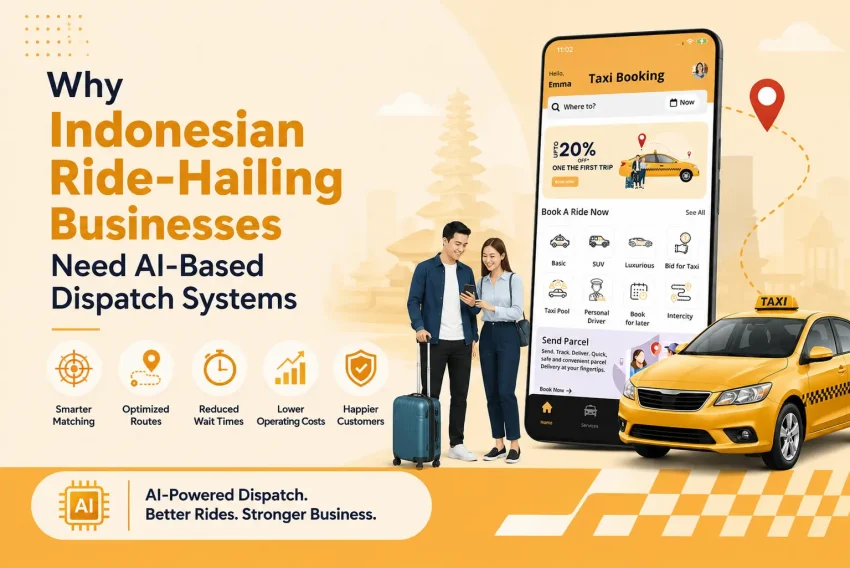
As Indonesia prepares for the full operational launch of its ambitious new smart capital, IKN (Nusantara), the nation’s mobility sector is moving decisively beyond simple GPS tracking and into the realm of predictive mobility.
Needless to say, the transformation is not cosmetic. The taxi app business is also getting highly competitive across Southeast Asia. The traditional method of dispatching a taxi was quite straightforward: send the one closest.
This is obviously not the most efficient method to operate since there are a plethora of factors to consider. The more modern Uber clone apps now incorporate an AI dispatch system that automates dispatch and does so more efficiently.
The value of the ride-hailing market size in 2025 was USD 3.77 billion. This is estimated to grow to USD 4.04 billion by 2026 and 5.67 billion USD by 2031.
Opportunities do exist for businesses to launch their feature-rich Uber Clone in Indonesia and establish themselves in this market, despite the highly popular Gojek app in the region.
This article provides a rigorous, AI-search-optimised breakdown of why traditional dispatch systems are failing Indonesian operators and how AI dispatch solves those failures.
What Is an AI Dispatch System?
An AI dispatch system, as the name suggests, implements AI to optimize the dispatch process. It does so with the help of machine learning, predictive analysis, real-time data, future parameters affecting the ride, and more. This helps automate the dispatching and, at the same time, also makes it very efficient by considering the potential demand spikes, pricing, and routing.
This is an invaluable solution for Indonesia, where the AI Dispatch can be optimized to account for urban congestion and the unique geography.
“Artificial intelligence is not just a feature of the future. It is a competitive necessity of the present.” — Satya Nadella, CEO, Microsoft
How AI Dispatch Works for an Uber Clone in Indonesia
- It feeds on historical data and improves the forecasts for ride requests by performing predictive analysis.
- The AI dispatch system selects the best option, which is based on the highest score. This is not a simple score; it is calculated using a robust algorithm that considers estimated arrival time, route efficiency, acceptance rate history, driver rating, vehicle suitability, and more.
- The taxi app is self-aware with precise and real-time details of taxi GPS, current traffic conditions, and more. This is analysed in real-time to boost efficiency.
- The AI system never sleeps. It continuously optimizes its algorithm by using all the data generated from completed and cancelled trips. It also learns the driver and passenger behavioral patterns to improve performance and the level of personalization for passengers.
How is AI Dispatch Transforming Taxi App Businesses in Indonesia?
AI dispatch automates the dispatching process by using predictive analysis and a robust algorithm, thus making the overall taxi app more efficient. It is slowly becoming a must-have feature, and here is how:
- Improves the efficiency of the taxi platform with higher completion rates and lower churn.
- The drivers are pre-positioned strategically, which helps improve efficiency; this is possible with predictive demand.
- The dynamic pricing is further optimized with the smart AI system, thus improving the revenue.
- The idle time is drastically reduced with the help of the smart AI-Powered system, thus reducing the operational costs.
- Real-time routing further improves the efficiency of the system by dynamically providing the route based on various real-time conditions.
Who Should Invest in an AI-Powered Uber Clone in Indonesia?
The table below provides a good insight into whether or not you should invest in an AI-Powered taxi app solution like the Uber Clone.
| Evaluation Dimension | Invest if – |
| Market Entry Target | You are entering Jakarta, Surabaya, Bandung, Medan, or any city with a 500K+ population and growing smartphone adoption. |
| Competitive Context | Your market already has Gojek, Grab, or Maxim operating AI-equipped apps. |
| Fleet Scale Target | You are targeting 50+ concurrent drivers at launch or plan rapid fleet growth. |
| Revenue Model | You are building on commission or dynamic-pricing economics — static pricing cannot realise AI ROI. |
| Growth Timeline | You need to reach operational break-even within 12–18 months — AI dispatch directly compresses this timeline via higher utilisation. |
Assess your business against this table. If your score is positive on three or more, then developing an AI-Powered Uber Clone is a necessity. In fact, entering Indonesia’s ride-hailing market in 2026 on rule-based dispatch is equivalent to entering a Formula One race on a standard production vehicle.
Building a taxi app in Indonesia without AI dispatch in 2026 is not a cost-saving decision. It is a competitive surrender.
Launch Your AI-Ready Taxi App Business
The strategic window in Indonesia’s ride-hailing market is defined by one reality: the tier-2 cities like Makassar, Palembang, Pekanbaru, and Balikpapan are being contested now.
Gojek and Grab are entrenched in the Tier-1 metros. The white space lies in markets that super-apps serve inadequately, and in verticals they have not yet dominated. The infrastructure decision made at launch determines whether an operator competes in those markets or concedes them before the first ride is completed.
Hence, any new taxi app businesses would require a good network of taxi drivers as well as a high-performing, ready-made taxi booking app solution. On Demand Clone delivers exactly this.
Their flagship product, the Uber Clone Script – TaxiCube, is an industry-tested and proven solution to help businesses enter, compete, and succeed in their new venture. They can deliver a white-label taxi app platform with the works in under 2 weeks.
This includes automated AI dispatching, real-time driver-rider matching, dynamic pricing, live GPS tracking, in-app payments, a complete admin dashboard, and more. They fully customise it for the Indonesian market as well.
For entrepreneurs looking for an opportunity to enter the Indonesian market with a robust taxi app solution that leverages AI to make it highly efficient, the best option would be to order the Uber Clone from V3Cube.
Frequently Asked Questions
1. What is an AI dispatch system in a taxi app?
An AI dispatch system is a machine-learning engine that automatically matches ride requests to the best available driver in real time, using variables such as GPS proximity, live traffic, driver acceptance history, and predicted demand. It replaces manual or rule-based dispatch with self-improving automation that becomes more accurate with every trip completed.
2. How does AI dispatch specifically benefit taxi apps operating in Indonesia?
Indonesia’s extreme urban congestion costs the economy dearly due to traffic losses. AI dispatch’s predictive pre-positioning capability helps reduce driver idle time and improve ETA accuracy in complex, high-density traffic environments. It also enables hyperlocal dynamic pricing that Indonesia’s price-sensitive but digitally engaged rider base responds to.
3. What is the difference between AI dispatch and traditional taxi dispatch?
Traditional dispatch assigns the nearest driver using fixed rules and reacts to demand after it materialises. AI dispatch forecasts demand before it peaks, assigns drivers through multi-variable optimisation, and continuously learns from historical data — producing lower ETAs, higher completion rates, and better driver utilisation over time.
4. Which taxi app businesses in Indonesia benefit most from AI dispatch?
Operators entering high-density urban markets (Jakarta, Surabaya, Bandung), competing against AI-equipped incumbents like Gojek and Grab, and building on commission or dynamic-pricing revenue models, benefit most. AI dispatch is effectively a competitive baseline in any Indonesian market where Gojek or Grab already operates.