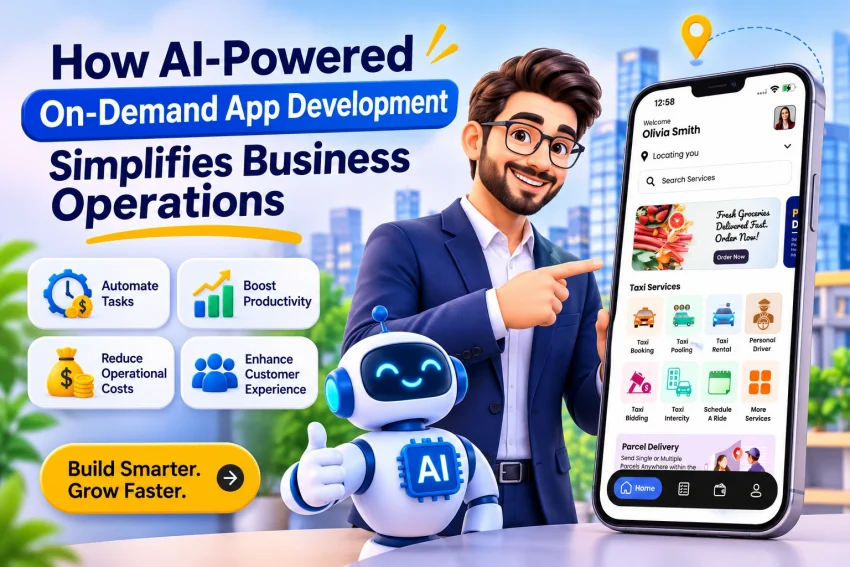
Applying different systems for managing multiple services might lead to operational difficulties for businesses.
AI-powered on-demand app development allows a method to unite transportation, food deliveries, grocery purchases, and home maintenance in one digital platform with the help of artificial intelligence for streamlining everyday operations.
An on-demand app can integrate these services by combining end-customer, provider, and admin applications into one platform.
With the help of AI-assisted automation and analysis of gathered data, businesses can reduce the load of routine tasks, manage service providers, determine consumers’ needs, and make better operational decisions.
How Does AI Simplify Daily Business Operations?
Conventional on-demand platforms often function through manual processes used to allocate requests, check service availability, respond to consumer inquiries, and evaluate performance.
AI can assist in these processes through the analysis of the operational data needed to carry out selected task automation.
For instance, by using AI in the development of on-demand applications, a business can implement intelligent allocation of requests, automated customer support, and demand prediction.
Some practical applications include:
- Automating standard bookings and service notifications.
- Finding service providers based on location and availability.
- Examining customer feedback and transaction behaviours.
- Forecasting busy periods for resource planning.
- Highlighting odd transactions for further analysis.
All of the above-mentioned capabilities would make the administrator’s operational management much easier and provide better visibility.
AI isn’t meant to replace the need for human supervision. Considering the benefits of this technology, businesses can perform their routine tasks at a high level of efficiency and concentrate on more complicated operational decisions.
Which Business Processes Can AI Improve?
A platform similar to Gojek takes care of many interconnected processes. AI can help each area in various ways, according to the data available and the requirements of the business.
| Business operation | How AI can help |
| Booking management | Helps categorize requests and automate booking updates. |
| Provider allocation | Recommends appropriate drivers or service experts in relation to their location and availability. |
| Customer support | Answers basic queries using AI chat assistants. |
| Demand planning | Recognizes trends in bookings and estimates future service requirements. |
| Fraud monitoring | Flags unusual payment or booking activity for administrator review. |
| Performance analysis | Highlights trends in services, feedback from customers, and operational gaps. |
There are various apps that can be used for AI-powered app development, which can be very important for businesses requiring coordination of different service categories without manually managing everything.
How Does AI Improve Customer and Provider Experiences?
For the multi-service application to function effectively for both its end-users and service providers, it must have an efficient operation. AI can facilitate better communication and help to deal with delays experienced when booking services.
Personalized recommendations:
The platform can provide personalized services depending on the previous bookings, interests, and activities of the customer. If a customer uses food ordering services often, then there will be relevant recommendations about restaurants or grocery stores.
Intelligent matching:
Matching based on AI technology can take into account the location, the availability of the service provider, the type of service, and other factors when handling requests.
Automated assistance:
Automated services such as chatbots help to process numerous requests related to bookings, payment, and cancellation, as well as to respond to customers about the service’s availability. The difficult requests will be automatically forwarded to human operators.
Demand-based planning:
Predictive insights can enable service providers and administrators to prepare for busy periods and those areas that experience higher booking activity levels.
These capabilities improve convenience and assist businesses in increasing the quality of the service provided.
What is the Use of Artificial Intelligence-Based Features in On-Demand App Development?
An on-demand app solution integrates different services that require administrators to understand different modes of customer activity and service provider efficiency.
On-demand applications based on artificial intelligence help with the processing of data and facilitate search results for hidden patterns that are not easy to find with manual analysis. For example, one platform may find out that ride requests increase during morning rush hour and online grocery orders rise during weekends.
Another use of AI technology is to pinpoint common instances of canceled bookings, common complaints raised by customers, and categories of services with low levels of interest. With the results in hand, administrators can enhance service processes and make substantial decisions regarding expansion.
The main benefit of using AI is in solving particular operational issues and not just adding complex features for the sake of creating a more modern application.
What Factors Should Businesses Take Into Account Before Investing In AI Technologies?
While artificial intelligence possesses the ability to enhance workflows, the applicability of its capabilities is dependent upon factors such as the quality of the data being utilized, the suitability of the integrations, and clearly defined goals for the business.
A practical investment approach includes:
- Identify operational problems: Find out whether the business deals with the issues of delays in booking, manual support, allocation of providers, and planning of demand.
- Select proper AI capabilities: Choose the features that address the issues that matter most for the business.
- Check availability of data: Make sure that the platform is capable of collecting and processing the required data on bookings, customers, and providers.
- Integrations planning: Consider the inclusion of different external AI services; this covers both automatic sorting methods as well as payment services and various other systems.
- Evaluation of the efficiency: The performance metrics should include response times, the rate of booking completion, retention, and the operational costs.
This method allows businesses to optimize unnecessary expenses and introduce artificial intelligence functions in parts of existing businesses.
How Does V3Cube Support AI-Powered On-Demand Platforms?
V3Cube provides clone app solutions that can be customized by businesses when setting up their multi-service platform decisions or on-demand app development.
The existing framework serves to minimize the number of standard application components that need to be developed, and the customization functionality makes it possible to effectively align the platform to the needs of the business workflow.
For businesses interested in AI-based business applications, an important factor to consider is whether the solution can provide the necessary AI integrations and the functions for customers, providers, and admins.
The assessment of the V3Cube offering may include available modules, options for customization, options for integration, and support arrangements.
Unlike selecting a generic template simply due to the feature list, businesses need to evaluate how well the proposed solution accommodates various types of services and any changes that may come up in the future.
They should also need to check which AI features are included and which require third-party services as well as if there are any extra costs involved in the development process.
Conclusion
The use of AI-powered on-demand app development simplifies the operation of businesses, since the technology allows for the coordination of bookings, service providers, customer support, and performance analysis through a unified platform.
The principal feature of AI lies in its ability to eliminate repetitive tasks and help businesses obtain significant data insights from their operational processes.
For businesses that are interested in the development of an on-demand application, a phased approach is usually more advantageous than implementing all the available AI capabilities from the start.
By beginning with feature implementation aimed at solving operational difficulties, a business can increase its efficiency while spending the same amount of resources.
FAQs
Q1. What is AI-powered on-demand app development?
It includes the development of on-demand platforms with the help of AI to assist in tasks such as matching providers with customers, predicting demand, providing customer support, and conducting business analytics.
Q2. Can AI manage multiple services in a Gojek clone?
AI can work across numerous industries effectively by analyzing the patterns of booking, recommending providers and helping admin with predicting service demand.
Q3. Does AI reduce the need for business administrators?
No. AI cannot fully replace human supervision in complex cases but is still a great assistant in automating tasks and providing useful insights.
Q4. Is AI necessary when launching a multi-service application?
Not always, A business can start with minimum requirements for booking and management features and adopt AI capabilities as operational requirements and data availability increase.
Q5. What affects the cost of AI integration?
The expenses depend on what kind of AI features will be implemented, whether a third-party service will be used, what the cost of ongoing maintenance will be, and what integrations will be applied.