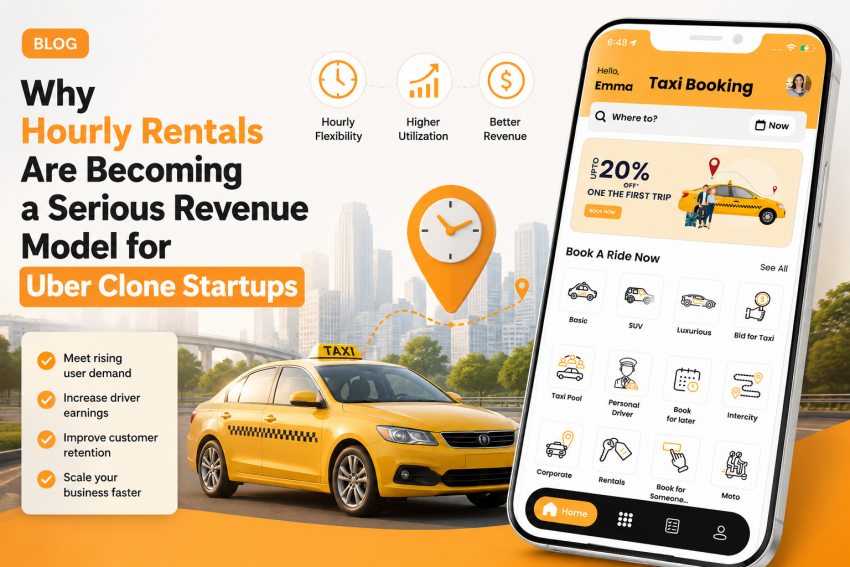
The way people use ride-hailing apps today is very different from how they used them five years ago. You can see this across multiple cities. Today, the average rider quickly opens a taxi booking app, treating it as a flexible mobility layer, rather than a point-to-point journey.
Part of this is due to changing lifestyles filled with unpredictable schedules. This kind of consumer behaviour now has a dedicated ride-hailing feature built around it that most startups are slowly understanding: hourly rentals. As a result, a white-label taxi booking software provider offers their “Rental Taxi” feature as an entirely configurable service type, where different kinds of operators can offer their vehicles for rent by the hour or by distance.
Many Uber Clone startups still focus on perfecting the single-trip model, which works best in dense metro markets. But the reality of the same model is very different in smaller cities. The people and their lifestyle are different and far more flexible. Riders often need a vehicle that they can use for an extended period and are happy to pay for.
Not just for a single destination, but for multiple destinations as well. Hourly rental structures also play a huge role in the driver income and fleet efficiency.
Why Rider Behavior Has Already Moved Beyond the Single Trip
This shift is forcing every modern Uber clone script to rethink how rides are structured beyond just point-to-point travel. It completely changes how operators, drivers, and riders value the service.
Adding a “Rent-a-Taxi” feature isn’t just giving users another booking option. For startups, it is a much-needed tool to grow their business and actually bring in more revenue. The market data backs this up. Ride-hailing is growing fast and is expected to hit from $235 billion to over $300 billion by the end of the decade. But the competition for those standard, short trips is brutal.
New startups simply can’t compete on price with the giant players who have deep pockets. Hourly rentals give newer businesses a way to avoid that direct competition, while also making every single booking much more profitable. Consumers in smaller cities are becoming increasingly comfortable with digital payments.
Because the technology gap between big metro areas and regional towns is shrinking fast, hourly rentals can now easily thrive almost anywhere.
The Case for Hourly Rentals Inside a Ride-Hailing Business
If you look at hourly rentals from the perspective of your drivers and your fleet, the financial benefits are obvious.
1. Keeping Drivers Busy and Earning
With regular short trips, drivers often waste a lot of time driving back empty to busy areas just to find their next passenger. Passengers don’t notice this “dead time,” but it costs drivers a lot of money. This is exactly why most modern ride-booking platforms are integrating hourly rental modules into their core dispatch systems.
Instead of stressing about chasing the next small fare, the driver gets a guaranteed payout for their time. Since your platform costs and payment fees are often fixed per transaction, getting more money out of a single booking massively improves your profit margins without you needing to magically find more passengers.
2. Serving the Needs of Smaller Cities
Big city ride-hailing models just don’t work the same way in smaller towns. Offering an hourly rental option solves this perfectly. It treats their entire morning of errands as one simple, predictable purchase, opening your app up to a whole new group of people.
3. Filling the Quiet Hours
For any taxi business, an empty car is a loss of money. During the quiet hours of the day, like late mornings or early afternoons, drivers usually struggle to find short rides. Hourly rentals naturally fill these slow periods. Studies on ride-sharing fleet optimization have also shown that better vehicle usage strategies can decrease passenger wait times by over 13%, showing how important continuous driver engagement is for platform efficiency.
A driver who picks up a three-hour hospital run or a corporate booking during a quiet afternoon is earning steady money instead of sitting idle. When drivers have a stable income mixed between short trips and longer hourly sessions, they are happier. And happier drivers mean a much better, more reliable experience for your riders.
Hourly Rentals Across Metro and Regional Markets
Earlier, hourly rentals were shown as something that works best in smaller cities where public transit is poor and people need to make multiple stops. This is mostly true. But the reality is that big cities and smaller towns simply use hourly rentals in very different ways. It doesn’t really compete with regular taxi rides.
Instead, it competes with corporate travel accounts and private car services. The taxi booking software allows operators in these big cities to run hourly rentals as a completely separate service alongside their normal rides. In smaller cities, however, the hourly rental model is far more practical for everyday use.
Families, local business travelers, and people running errands use it a lot. It is not a premium feature, but something that fills the gap for people who don’t own a car and don’t want to rely on single app bookings. The cars might be basic economy vehicles and the prices lower, but the core idea of booking a vehicle for a block of time remains exactly the same.
Part of this growth is also due to how people pay today. Digital payments handle trillions of dollars globally, which is important for hourly rentals because they usually require riders to pay or pre-authorize their card upfront. As riders in smaller cities become more comfortable doing this, the customer base for hourly rentals naturally goes up. The only real difference between offering this in big cities and smaller towns is the setup. This includes the minimum booking hours, pricing, the kind of cars used, and who the target audience is.
Operators in smaller cities often find that a 90-minute minimum works best for the local lifestyle. Meanwhile, big city operators might see that four-to-six-hour corporate bookings bring in the best revenue.
Final Thoughts
Hourly rentals are not going to completely replace the standard quick trips on ride-hailing apps. That was never really the point. The truth is that if a taxi business only focuses on getting people from point A to point B, drivers will end up with a lot of empty time during the day where they make little to no money.
A single booking model just cannot handle all of this. Most next-gen taxi app solutions already come with built-in rental, pooling, and corporate ride modules instead of focusing only on standard taxi booking flows. They understand that people’s real-world travel needs require more than just one way to book a ride. The technology is already there. Paying digitally is easier than ever, and we already know that riders in many cities want this kind of service.
Now, it comes down to the business owners. They need to understand local travel patterns well enough to figure out the right pricing and what kind of hourly packages to offer to get consistent bookings. Success with this is not really about the software anymore. It is mostly about paying attention to the local market and understanding how people actually travel.