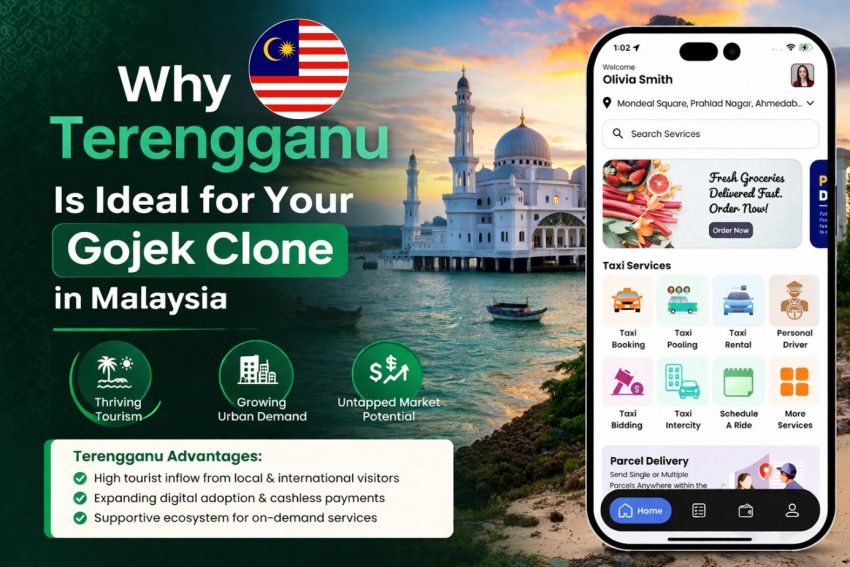
If you’re thinking of the idea of launching the Gojek Clone in Malaysia, the first question people will ask is: what city?
Kuala Lumpur (KL) is the most obvious choice. Big population, high smartphone usage, strong digital infrastructure. But there’s a issue with KL. Grab already has it. inDrive, Maxim, and Bolt have entered the market within the past twelve months. There is a lot of competition The costs to acquire customers are excessive and standing out is a challenge.
The more important thing to consider is the place where the majority of people are. It’s where the greatest opportunities are. When you examine all the information, one place is always being the solution: Terengganu.
Malaysia’s Ride-Hailing Market Is Booming but Unevenly Distributed
The market for Malaysia’s e-hailing is estimated at $490.98 million in 2025. It will likely to increase to $670.64 million in 2030, according to Knowledge Sourcing Intelligence. This is an ongoing 6.44 percent annual compound growth rate for a country in which smartphone penetration is high and congestion in traffic is real and public transportation in the absence of the major cities is not yet available.
However, that growth isn’t equally distributed across the entire state. It is mainly concentrated on Kuala Lumpur, Penang, and Johor Bahru. They are among the towns that the major platforms are battling over. That’s why the remainder of the map is intriguing.
25.02 million International visitors came to Malaysia in 2024, which is a 24.23 percentage increase over prior year. Malaysia also had more than 260 million visits from domestic visitors during the same time period that is an incredible amount. But not all of them arrive in KL. A lot of them are heading toward go to the East Coast. And Terengganu is at the very heart of it all.
Why Terengganu Is the Right City to Launch a Super App in Malaysia
This is what transpired during Terengganu in 2024, which the majority of users in the app industry did not notice.
The state had set a tourist goal of 4.5 million visitors in 2024. The year ended with 7.8 million visitors according to Bernama and more than double that of the prior year’s 3.5 million. It’s more than 73% higher than the goal. Traffic along the East Coast Expressway 2 into and out of Terengganu increased by 6.3 percent over the course of the year, and the numbers of passengers using Sultan Mahmud Airport rose as well.
In the same vein there was a report from at the same time, East Coast Economic Region Development Council (ECERDC) announced RM3.1 billion of realized investments that will be flowing into Terengganu in the year 2024 in the year 2024 alone. This investment is expected to flow through tourism, manufacturing as well as petroleum and natural gas. Large Petronas oil and gas complexes operate close to Paka and Kerteh as well as foreign direct investments into the state was 65percent of the new investments and Japan alone investing RM660 million.
What does this mean that on the ground is that there’s an increasing number of employees, business travellers tourist, residents and employees who require transport, food delivery, parcel delivery, and day-to-day daily convenience on demand. At present, there is no one platform that can provide all of those needs with one application.
Grab covers the major corridors between cities, but doesn’t possess the local depth Terengganu’s sprawling geography demands. There isn’t any dominant player that connects the islands and areas of industrialization, cities in the interior, and cities along the coast into a single service layer. This is precisely where Gojek Clone steps in.
What a Gojek Clone Can Do for Terengganu That No Single App Can
The Gojek Clone is a multi-service platform. In contrast to a ride-hailing application which only deals with transportation the Gojek Clone lets operators bundle several services into one package.
For Terengganu it is more crucial than any other place on the island of Malaysia because the demand for Terengganu is not uniform. It’s spread over different kinds of users and usage cases.
Tourists who are planning to visit Redang, Perhentian, or Kapas Island need airport and Jetty transfer services. They need meals delivered from nearby eateries when they stay in hotels near the beach. They require luggage and parcel transportation between the hotels.
The workers in the oil and gas facility located in Paka and Kerteh require daily transportation alternatives. Some are employed in rotating shifts and the transportation demand is present during hours that taxis are not.
The residents of Kuala Terengganu need grocery delivery along with home services and rides on a daily basis. Kuala Terengganu’s populace of 300,000 have the mobile penetration and digital payments practices to enable a robust online-based platform, but there’s no local super app that’s come up to help them.
A Gojek Clone addresses all three of these user groups within one application. This is not a project that is small. You are creating the infrastructure for on-demand that the state currently is lacking.
How Your Gojek Clone Earns Money in Terengganu
A revenue-based model like Gojek Clone’s revenue model Gojek Clone works well in the market of Terengganu because the platform can be used in many verticals from day one.
Commissions for rides from every journey constitute the primary income. You get a share of every fare. This increases as the network of drivers you have.
Food delivery fees and parcel orders create another revenue stream that is independent that of ride-related business. Restaurants located in Kuala Terengganu and surrounding towns are able to reach customers via the internet and you earn money every time they take a customer’s order via the platform.
Home services, service fees professional on-demand services, other categories that are based on task add an additional layer. As the platform builds trust from local users the number of users increases naturally.
Tourism partnership agreements with resorts, hotels and island operators represent an opportunity that is unique to Terengganu. Pre-booking travel packages for those who have thought of a trip for Redang and Perhentian can be a lucrative and low-competition revenue stream which is not available in Grab nor any other platform.
Corporate accounts with gas and oil companies operating in Kerteh and Paka provide predictable large-volume bookings which stabilize your monthly income and decrease the dependence on individual orders from consumers.
Why Starting in Terengganu Gives You an Advantage That KL Cannot
The ability to enter into a market before competitors establish themselves is among the very few real strategic advantages of the business of apps. Once a platform is established with the driver supply, trust of users and brand recognition within the city, replacing it can be expensive and time-consuming.
Terengganu is in the midst of a tipping point. Tourism is on the rise. The investment is flooding into. The number of employees is increasing. The infrastructure for digital is in place. However, no one has created the most popular super app for this particular market.
The window isn’t open for long. Every month the probability of a different operator being able to see the same opportunity expands.
A Gojek Clone gives you everything you require to get into the market quickly. The technology is available. Multi-services fit to the marketplace perfectly. The Terengganu mix of tourists, industrial workers and urban dwellers gives you numerous customer bases to serve starting the moment you open.
Conclusion
KL is always regarded as the most valuable prize. However, big prizes draw the most interest. Terengganu is a major market that has 7.8 million visitors annually, RM3.1 billion in fresh investment, and there is no super app.
This is the type the gap which defines a company. A Gojek Clone built for Terengganu now is poised to be the primary on-demand platform used across throughout the East Coast corridor tomorrow.
If you’re ready to launch a revolutionary application in Malaysia which can truly own its market, instead of competing for scraps, Terengganu is where you begin.