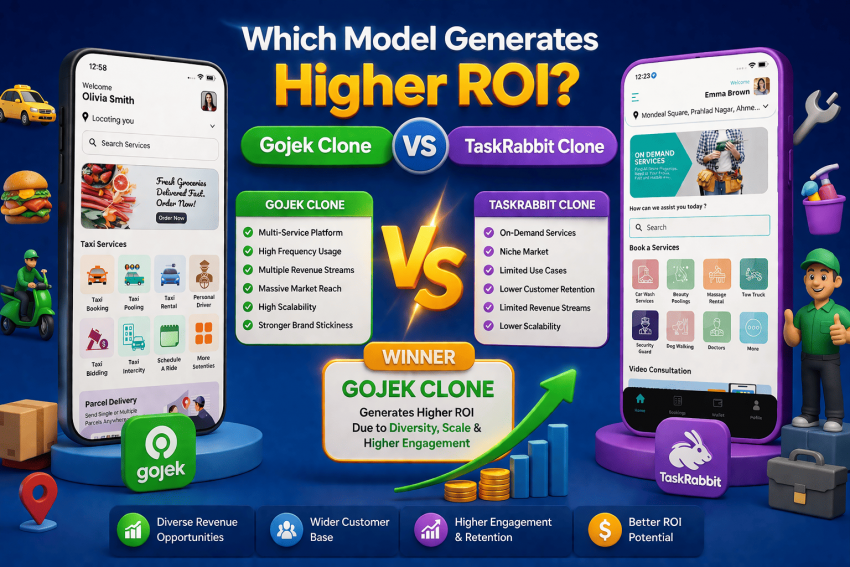
Are you considering entering the on-demand app industry? You must have heard the saying “Do not put all your services in one basket”. But here’s the truth: what if one App lets you own the entire on-demand services, while another helps you rule one market?
That’s exactly the difference between a Gojek Clone and a TaskRabbit Clone.
Both are powerful, both are profitable, and both tap into the booming on-demand economy. But their business models? Completely different. So, if you’re an entrepreneur wondering where to invest your time and money, then this blog will help you make an informed decision.
Gojek Clone App Model
multi-service Super app that combines all the services into one app. It prioritizes user engagement and revenue streams through multiple means. Hence, it is perfect for big companies. The Gojek Clone app is made to be an all-in-one On-Demand app. Everything, from booking cabs to getting your food delivered, cleaning services, and package delivery, takes place within a single app.
This is a simple thought: why should someone download 10 apps when they can have it done through one app? This concept not only draws customers but also makes them stick with the app.
Core Features of the Gojek Clone Script
- One application for many services
- User Panel, Service Provider Panel, and Admin Panel
- Service providers get matched with clients in real-time
- App wallet feature and many payment methods
- Business analytics dashboard for the owners
This is not only an app but a digital universe.
How the User Makes a Booking through the Gojek Clone App?
- The user selects the service through the app
- The app connects to the nearest service provider
- Real-time tracking of every task
- Payment is done online
- Quality improves as a result of ratings
Revenue Model of Gojek Clone App
- Percentage commission on each service
- Surge price during busy hours
- Delivery fees and convenience charges
- Vendor subscription plans
- Advertising and featured services
The business model is based on the “multiple taps multiple earnings” concept.
Reasons for Entrepreneurs Choosing Gojek Clone
- Scalability to various other industries
- Higher customer retention thanks to diversity
- Effective brand-building ability
- Multiple revenue streams
It’s similar to having a whole mall rather than a single shop.
TaskRabbit Clone Model
The TaskRabbit Clone model is a task-based marketplace connecting users to service providers based on specific work orders. Its emphasis lies on service matching and simplified operations.
The TaskRabbit Clone is an on-demand marketplace platform. As opposed to other models, it connects users directly to people who can handle specific tasks. Tasks may range from housecleaning, moving, to assembly and repair jobs.
Working of the TaskRabbit Clone
- User posts a task
- Service providers (taskers) search for or get notified about the request
- Taskers bid for the job or accept it
- User selects the service provider
- Service delivery is done
- Payment processing is done through the site
This model is based on one-to-one fulfilment of services.
Key Features for the TaskRabbit Model
- Task posting tool
- Profiles for the service providers
- Bidding/acceptance system
- Messaging feature
- Payment and rating process
The site serves as the intermediary point between demand and supply.
Revenue Generation Model
- Commission per task delivered.
- Service charges paid by the users
- Subscription for the tasker
- Premium take posting
Revenue generation from the transaction within a particular service range.
Operational Aspects of the Model
TaskRabbit Clone is comprised of the following:
- Handling task postings and requisitions
- Building a community of service providers
- Establishing communication channels between users and taskers
- Making sure tasks get done and payments are made
- It is created to achieve efficient and concentrated service provision.
Gojek Clone vs. TaskRabbit Clone: Comparison
While Gojek Clone seeks volume and diversity, TaskRabbit Clone concentrates on efficiency and specialization. It comes down to your business objectives and available resources.
| Factors | Gojek Clone | TaskRabbit Clone |
| Business Approach | Multi-Service App | Service-Based App |
| Services | 101+ on-demand services | Specific service category |
| Time to Launch | 1-2 Weeks | 1-2 Weeks |
| Users Engagement | Very High | Moderate |
| Operational Focus | Various Job Seekers | Service-Based Provider |
| Cost | Affordable | Affordable |
Which Model Would Be Better for You?
If you are looking at scalability and making good money in the long run, then you should go for the Gojek Clone. If you are looking at starting your business faster and focus on task services, then you must opt for the TaskRabbit Clone. Simply put, here is the scenario:
For building a business empire, a Gojek Clone would be better.
For growing your business steadily and leanly, the TaskRabbit Clone would be a better option.
Conclusion
To summarize, knowing about both these models is not as much as learning about how they function.
In the case of Gojek Clone, the model depicts the functioning of how a business can grow through many service offerings. While in the case of the TaskRabbit model, the platform can offer task-based services to connect buyers and sellers. Both have a proper structure for implementation, but the methods of implementation, scope, and flow vary. In case you wish to know more about these two different types of clone platforms, nothing beats a live demo.