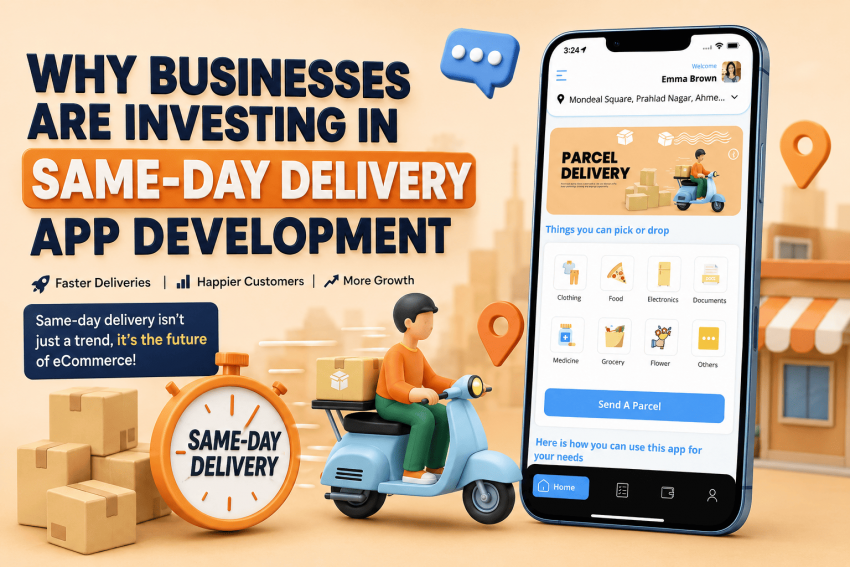
Have you noticed how customers no longer ask, “When will it arrive?” Instead, they ask, “Can I get it today?”
A single question reveals it all. Customer behaviour has undergone a change, and prompt deliveries have become a necessity. It is the new norm. People now demand their parcels, documents, groceries, gifts, and official things delivered within the very same day, failing which they can switch to another company offering better services.
And this is precisely why On-demand Logistics App Development is revolutionizing the entire process for businesses by allowing entrepreneurs to create delivery portals that operate swiftly and cater to customer needs effectively.
It’s written all over the wall companies who keep up with the pace of same-day deliveries will continue to remain ahead of the curve.
Reasons Behind The Change In Customer Behaviour
Customers were happy to wait for their deliveries to be made in three to five days. No more patience anymore. What happened? Digital platforms have conditioned people to have everything instantly delivered. Foods get delivered instantly. Cab service arrives almost immediately. Streaming movies happens without delay.
It stands to reason then that customers would demand the same promptness even in parcel deliveries. They want a solution right now. This shift in mind-set has created huge demand for businesses investing in On-Demand Logistic App Development.
The Old Delivery Method Had Too Many Gaps
Earlier, people often relied on two methods:
- Sending a friend or employee personally
- Waiting for someone already traveling that route
- Using traditional courier systems with uncertain timing
These methods were full of guesswork.
- Would the parcel arrive today?
- Would it get delayed?
- Would it be handled safely?
- Would anyone provide updates?
So many loose ends, so much doubt. That’s when the delivery apps came into the picture and turned the tables around.
What is On-Demand Logistics App Development?
On-Demand Logistics App Development refers to developing a digital infrastructure where your clients can book their pickup and delivery services immediately via a mobile application. Users can:
- Schedule same-day parcel delivery
- Choose pickup and drop location
- Track the delivery live
- Pay online or cash on delivery
- Receive proof of successful delivery
In essence, it makes logistics service swift, efficient, and client-oriented.
The Required Features for On-Demand Logistic Apps
Developing a logistics application does not mean creating an appealing user interface, but making an application that helps to solve real-life market problems. In order to build a sustainable platform, you need certain features which guarantee trust and effectiveness. Here are key aspects to take into account when developing On-Demand Logistic App:
1. X-to-Y Delivery
Modern customers do not want to come down to pick up their goods. Instead, they want the delivery process to be convenient by managing all aspects of the logistic chain, from pickup, through route planning to delivery right to your doorstep.
2. Real-Time Tracking and ETA
Uncertainty is the enemy of customer satisfaction. Both the sender and the receiver should have eyes on the parcel at all times. Providing a precise, live ETA isn’t just a “nice-to-have” it is a critical tool that drastically reduces customer service calls and complaints.
3. Proof of Delivery
Not receiving the package is one of the worst nightmares when it comes to the field of logistics. Your application will be expected to provide evidence of delivery in the form of photographs, signatures or specific SMS codes. This way, you remove any chance of arguments from your equation.
4. Flexible Payment Methods (Cash on Delivery and Digital)
Though the trend moves towards online payments, there are still some markets (Turkey for instance) which rely heavily on cash on delivery. An effective app will need to incorporate both payment methods – COD and card payments as well as digital wallets.
6. Route Optimization and Consolidation
Time equals money. Thus, your application will need to optimize the delivery routes by consolidating packages for the same destination into a single run. In this manner, you reduce fuel expenses as well as decrease vehicle wear and tear.
8. APIs Integration
The logistics app must be integrated flawlessly with the broader world of e-commerce. Your application should enable the merchants to bypass entering order details twice via an API integration process.
9. Security and Compliance
As a provider of goods and payments, you will also deal with information. Make sure that your architecture follows any relevant local legislation concerning information security as well as finances. Once this puzzle is solved, your application will no longer be simply an application but the foundation for your parcel delivery service.
The Power of White-Label Firms
There is an old saying: “Don’t reinvent the wheel.” When you are ready to launch your logistics platform, you don’t necessarily need to spend years coding from scratch. This is where professional white-label firms come into play.
A white-label firm brings more than just code; they bring practical, battle-tested experience. They have already done the heavy lifting by building pre-tested delivery modules. By working with them, you will gain:
- Pre-Made Solution: Proven designs that help speed up your time to market.
- Regulatory Compliance: Most of them offer compliance mechanisms regarding payment and taxation systems, among others.
- Cross-Platform Capability: Their applications run seamlessly on different operating systems, such as Android and iOS.
- Source Code & SLA: You maintain control over your digital asset, supported by expert service level agreements.
Choosing an experienced white-label partner reduces risk. You aren’t paying a vendor to “learn” how to build a logistics app on your dime; you are paying for a proven product tested in real-world markets.
Launch Strategy: Bringing Your Idea to Life
Once you’ve made up your mind to venture out into the realm of on-demand services, you will need to think about planning ahead. Good launch team members understand that a step-by-step process is key:
- Discovery and Regional Laws: Defining your zones, payments, and policies will need to be done way before any coding takes place.
- Customization and Training: Work with a trusted third party to customize your application and set up payment solutions. Meanwhile, concentrate on recruiting drivers and merchants.
- Beta Testing: Running a beta program becomes necessary at this stage. Begin small by testing your application in a closed geographic region.
- Growth and Optimization: Following the success of your pilot program, go all out and scale your business in new regions. Optimize your batch deliveries and establish strong connections to e-commerce portals.
A phased launch model allows you to fine-tune your services to fit the needs of your customers, which means that you can expand confidently and with conviction.
Conclusion
Same-day delivery has forever changed the mid-set of customers. Speed, visibility, and convenience have become paramount values, and if your company cannot deliver on them, another company will. It’s high time that you invested in On-Demand Logistics App Development and established a delivery firm that customers can rely on. Time is of the essence, and you must be quick in selecting your technological partner.