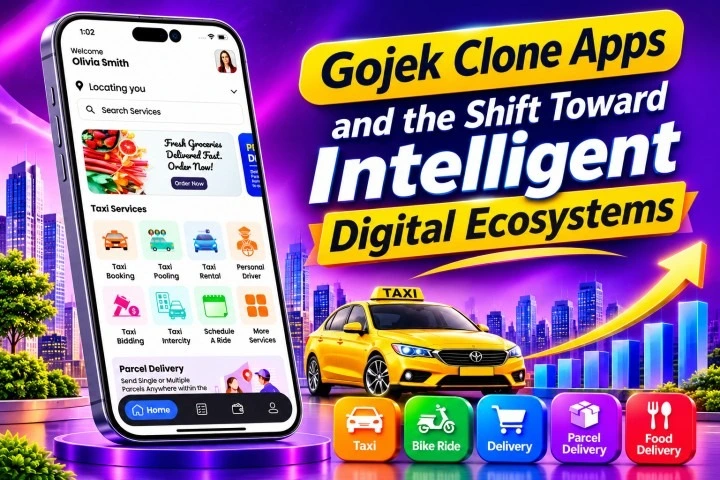
Digital platforms are starting to go beyond single-use application formats. Customers expect to carry out a variety of everyday activities like booking cabs, ordering meals, buying groceries, sending parcels, and utilising multiple other services.
The Gojek Clone app provides access to multiple services using an interconnected platform. Furthermore, automation, data analysis, and artificial intelligence are now commonly used to make platforms more advanced and intelligent.
Moreover, in order to make these applications functional as operational systems, businesses can employ tools like automation, analytics, and intelligence. It is these tools that allow the development of connected business processes or systems, which help in the management of all aspects of business operations.
Contact V3Cube to Build Your Intelligent Gojek Clone App
Build a smarter Gojek Clone App with V3Cube’s AI-powered, customizable solutions.
Enquire Now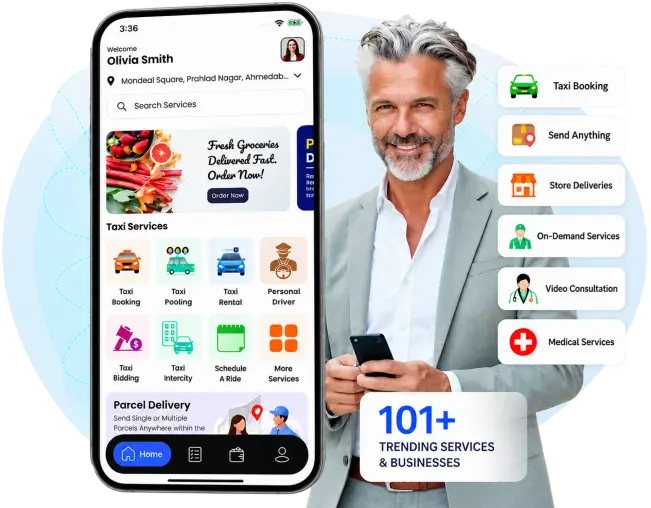
From Multi-Service Apps to Intelligent Digital Ecosystems
Traditionally, a multi-service application aggregates multiple services into one interface. But an intelligent platform does more by interconnecting the operations, data, and processes behind each service.
For instance, a regular customer who orders from a restaurant delivery may be interested in grocery delivery or parcel service, in addition to the food ordering service. Hence, the customer activity data in the intelligent ecosystem can help recommend such relevant services and improve search discovery.
These intelligent digital ecosystems can integrate the following entities:
- Multiple service-seeking customers
- Drivers, merchants, and service providers
- Payment and delivery network
- Operational team
- Data and automation systems that can aid business decisions
The idea is to bring together such different services to create synergy instead of individual business processes and services being isolated from each other.
How Gojek Clone App Development Is Changing
In recent times, the main aim of All in One App was to allow users the option to book services through one app. Modern development approaches take this idea further as they also aim to ensure that services share information seamlessly and respond to customer behaviour.
For example, an app development that follows the Gojek Clone app development approach comprises five key layers, as follows:
| Layer | Purpose |
| Customer interface layer | This layer provides assistance to the end users through discovering and booking services |
| Provider interface layer | It gives professionals the option of managing orders, drivers and merchants |
| Admin dashboard layer | This layer helps the business in managing various business functions through a central interface |
| Backend infrastructure layer | This interface allows for seamless communication across app components and processes requests. |
| Intelligence layer | The intelligent layer is responsible for providing customers with relevant information and customising their experience. |
This structure gives businesses a foundation that can support new services and technology as requirements change.
The Role of AI in the Modern Super App
The introduction of artificial intelligence has had a massive impact on the way multi-service applications deal with everyday operations involving customer relations. An AI-Powered super app has the capacity to use smart solutions to improve discovery of its services and automate routine processes.
Examples of useful implementations can be:
- The app can make recommendations of services, depending upon users’ preferences, past visits, and their usage patterns.
- AI-powered chatbots can respond to frequently asked questions and inform users about the status of their bookings, as well as provide help during their initial steps.
- Historical booking data can be used to understand demand in terms of service types across various locations to help businesses estimate demand.
- The use of an intelligent system makes assigning ride requests to appropriate drivers easier by utilizing parameters such as location and availability.
The list above shows the types of AI systems that businesses can choose based on their needs, objectives, and other internal and external factors.
What Makes AI-Driven Digital Ecosystems Different?
The most important distinction between a multi-service platform (i.e., a standard multi-service platform) and AI-driven digital ecosystems is how data is utilized by the business in question.
In the case of a regular multi-service platform, the following operations take place separately: management of booking taxi services, placement of food orders, and grocery deliveries. However, the ecosystem-based platform analyzes activity across all services to establish patterns, make interconnected decisions, etc.
Examples include:
- Booking trends can provide estimates on peak time needs.
- Customer activity can generate relevant suggestions to other customers.
- Provider performance can lead to identifying service gaps.
- Automated notifications can give customers information on their pending services.
- Operational reports can help in determining which service is better or worse.
The result is a platform that not only deals with services and transactions, but it also provides the ability to analyze functions within the platform and suggest improvements in each service.
Why Businesses Are Moving Toward Connected Digital Platforms
A single integrated platform will provide multiple benefits to a business when planned to address both the needs of customers and business operations.
A single point of access for multiple services
Customers will have the facility to access different types of services without the need to install different applications for each of them, thereby improving the experience of users.
Better leveraging of business data
Centralised data will allow administrators to have insights into the bookings and revenue trends, along with information about activity by the service providers for each type of service on the platform.
Improved operational performance through automation
Automation features will assist in removing repetitive administrative tasks and improving the notification mechanisms to streamline the process of booking.
Potential for growth through introduction of additional services
Businesses can scale further based on an increase in demand, as well as capacity in the system to add more services and outlets.
Building a Multi-Service Digital Platform: What Should Businesses Consider?
A Multi-Service digital platform is considered successful if the platform can handle more than one service at a time. However, businesses must have adequate resources and technological infrastructure that can support the operation efficiently, even when the platform expands.
Some key factors are as follows:
- Customers: First of all, you should identify services that customers need more of, rather than expanding the service category.
- Integrate systems: You need to ensure that the platform has all necessary components, including customer apps, administrator apps, service delivery apps, etc. These systems must work and share necessary data without issues.
- Choose useful integrations: payment gateways, maps, notifications, and similar third-party services will work well with the planned services.
By following the above-mentioned steps, unnecessary difficulty and complexity are avoided.
How V3Cube Supports the Shift Toward Intelligent Super Apps
Creating a connected platform from the ground up would require a lot of effort for customer applications, provider interface, admin tools, and infrastructure setup. V3Cube provides a pre-developed Gojek Clone solution that offers an existing foundation for businesses to combine services together in one single place.
One of the benefits of this solution is a multi-service approach. Businesses can evaluate different service modules within a single platform and can take all services as one application. In this way, all the services like customer interface, provider interface, and admin tools are available for managing platform activities.
V3Cube also offers AI-related capabilities to businesses that they may want to factor into their operational plans. This allows businesses to review not only multi-service functionality but smart features also within one solution, rather than planning them as entirely separate products.
All AI-based functions, integrations, customizations, source code licensing conditions, and scalability needs should be considered as part of a product demonstration. Thus, a business can be sure that the purchased configuration will correspond to its real business models.
Conclusion
The future is multi-service applications connecting services, information, and business operations smartly with the help of smarter technology. With AI, automation, and analytics, these make them a lot more useful for the platforms as well as less difficult for business operations in terms of management.
V3Cube has a pre-built solution from which businesses can begin implementing their own connected solution, combining multiple service modules and AI capabilities to suit an enterprise’s specific strategy.
FAQs
Q1. What is an intelligent digital ecosystem?
It is a digital environment that connects applications, services, users, and data to support business operations, as well as customer experiences.
Q2. How can AI improve a multi-service application?
AI can help with personalized recommendations, customer support automation, demand forecasting, service assignment, and business analytics.
Q3. Can new services be added after launching a Gojek Clone platform?
Yes. Depending on the platform’s capacity and other limitations, additional service categories can also be developed based on business needs, as well as the readiness of the operations.
Q4. Is a ready-made Gojek Clone suitable for startups?
This can serve as a good foundation for entrepreneurs who want to have an existing ecosystem of services to build upon.