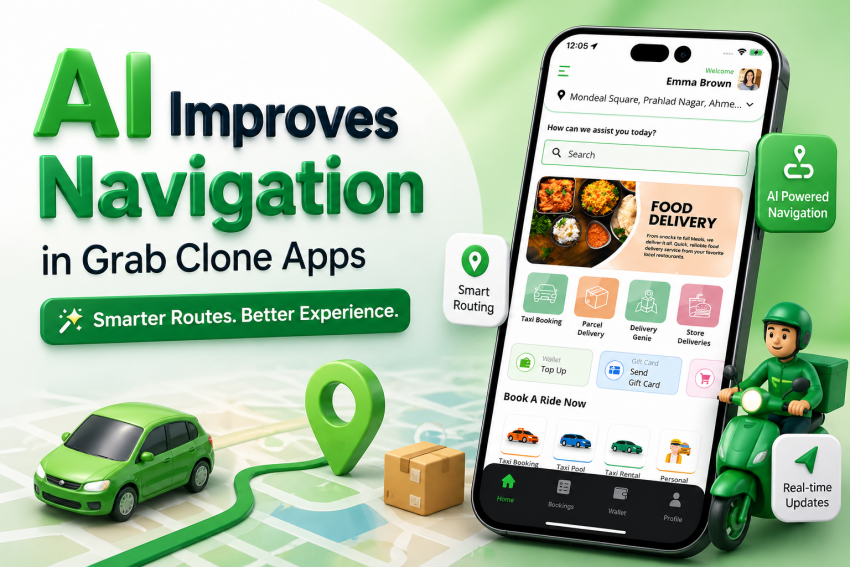
Why would someone choose to remain loyal to a particular Super App or Ride-Hailing App but remove another one? Why does the driver earn a higher income in just one day by completing more trips? How does an efficient on-demand company cater to the needs of its customers and drivers simultaneously?
It can be quickly and easily accomplished through the application of smart technologies to save time and make journeys effective.
Users demand prompt pick-ups, accurate estimates, smooth journeys, and fair prices while the drivers prefer more book-ins, minimized wait times, efficient routes, and increased daily earnings. If your platform satisfies both sides of this equation, then you are one step ahead of your competitors. In this case, AI-driven Smart Route Intelligence in a Grab Clone Application proves to be a game-changer.
A modern Grab Clone App is no longer limited to booking rides and showing maps. The system acts as an intelligent mobility system that leverages artificial intelligence to monitor traffic, weather, location of drivers, demands from the customer side, and road conditions in real-time. It helps in choosing the most appropriate routes to serve the user effectively.
What is AI Route Intelligence?
AI route intelligence is like a digital nervous system for your fleet. With machine learning (ML) and predictive analytics technologies, it does everything that a human dispatcher cannot: processes real-time environmental data to improve decision-making. But how? AI Route Intelligence takes into account such factors as:
- Traffic flow dynamics: anticipates traffic jams before they even appear.
- Weather effects: changes the ETA depending on weather conditions.
- Predictive demand: spots high-probability zones of ride requests.
- Driver availability: plans trips based on the driver’s workload and schedule.
The Driver’s Point of View: Why They Will Stay with You?
In the on-demand industry, your fleet is your most valuable asset. If your drivers aren’t earning, they aren’t working for you.
By introducing AI routing for them, not only are you helping them find their way but optimizing their revenues per hour. Reducing “deadhead” miles (travelling with no passengers in the car) and avoiding wasteful stop-and-go routes help you optimize the number of rides your drivers take each day.
What will be the outcome of this strategy? Your drivers will stay with you longer. When your app appreciates the drivers’ time and maximizes their revenues, drivers won’t leave. As a result, you will have a stable and reliable fleet. And what can make your users happier than a stable and reliable fleet?
How Does AI-Based Routing Work?
At the core, AI-based route optimization is all about using machine learning algorithms to calculate dozens of parameters simultaneously. Contrary to ordinary navigation software that gives a suggestion and leaves it like that, the AI engine adjusts its decisions constantly depending on the surroundings.
While calculating a ride price, the algorithm doesn’t look at the most optimal route in terms of distance. Instead, it considers the fastest route based on the following criteria:
- Traffic: The algorithm tracks micro-congestions and finds alternative routes before the driver enters the jammed road.
- Climate Changes: It predicts the impact of rainy days and storms and calculates the time to reach the destination accordingly.
- Time Windows: It considers whether the delivery is time-sensitive and ensures your most important deliveries receive priority.
- Fleet Capabilities: It knows the number of passengers each vehicle can carry and the status of your drivers to ensure you don’t assign a job to a driver who requires rest.
- Live Notifications: If there is any unexpected closure of a road due to any event or construction, the app sends an instant notification to the driver’s interface and recalculates the route.
The constant re-calibration eliminates the risk of a “cascading effect” that could lead to late deliveries.
5 Key Benefits of AI Route Optimization in 2026
When you work as on-demand app, the perks of adopting AI routing aren’t just a technical point. They affect your finances and your brand image.
1. Rapid and Effective Deliveries
Your most important resource is your time. In route optimization, you cut down the idle time of your drivers by reducing traffic congestion. Maximizing efficiency means that you get things done on time while maintaining excellent customer ratings.
2. Modification of Routes in Real Time
In case of any accidents occurring on the roadways, AI will help re-route all the drivers. In contrast to the static nature of traditional routing, AI adapts to changes dynamically. It makes the difference between a “good” service and a “reliable” one. Your clients aren’t concerned with traffic; they need an ETA.
3. Reduction in Fuel and Operational Costs
The cost of fuel is one of the major expenses incurred by your drivers. With roundabout driving and inefficient routes, the driver burns more fuel and wears out his car faster. Through AI, there will be no need for unproductive driving or idling, meaning that more money goes straight into the pockets of the drivers. A satisfied and profitable driver will remain loyal to your app, and driver retention is key to its long-term success.
4. Improved User Experience with Accurate ETAs
What frustrates a user most is the experience of being given a “ghost ride” or seeing the estimated time of arrival (ETA) keep changing and becoming even further away. Through intelligent logistics, you will have accurate tracking and automation of information.
Choosing the Right Routing Tool: What Matters Most?
Not all “smart” routing tools are created equal. When selecting an integration for your Grab clone app, don’t be swayed by feature volume. Focus on these three pillars:
Constraint handling. It’s the absolute must-have. Does it know how the real world works? Is it able to take into account such parameters as driver availability, vehicle type, service time windows, etc.? If not, there’s no use discussing its routing capabilities it’s just an abstract concept.
Real-time integration. An optimal route loses its value immediately after being calculated. The routing engine should process live feeds from GPS, traffic and orders. Otherwise, it won’t make sense at all even a few minutes’ delay will make it utterly useless.
Scalability & easy integration. A routing engine must integrate easily with your dispatch system, TMS, and driver app without breaking a sweat. Otherwise, it would be nothing but a nuisance.
Conclusion
The Grab Clone Application will survive in the current era only if you focus on the user experience and profitability for the driver. This is where AI Route Intelligence comes into play. It converts the unpredictability of the urban environment into a smart route optimization procedure that will bring you more profit and higher user satisfaction.
If you do not use AI to optimize your route, you are missing out on something vital. Stop living in the past and join the future!