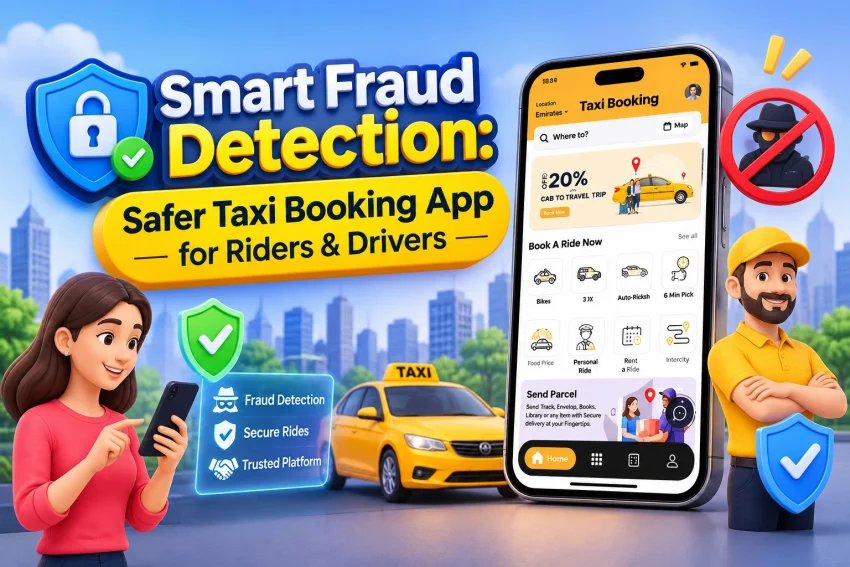
With the adoption of smartphone technology, we are seeing a definitive rise in the number of frauds happening across industries. In fact, there is no industry that has not faced this ordeal one time or another.
It is also happening in the transportation industry. We have seen drivers reject a ride at a lower price and then ask the riders to pay more. Such occurrences, although rare, are still happening in the transportation industry.
Hence, there is a need for smart fraud detection for taxi booking apps. Such examples prove one thing: fraudsters will never fail to surprise you when it comes to committing fraud. It is your duty to include AI fraud detection that can help with fraud prevention in taxi apps.
In this write-up, we will look at the different ways taxi app security can be enhanced and ensure rider and driver safety.
Before we start, let us answer this question –
What are the smart fraud detection methods to make your taxi booking apps more secure?
- Behavioral analytics
- Real-time monitoring
- Anomaly detection
- Integration of fraud detection algorithms
- Usage of GPS accuracy monitoring
We will discuss each of these AI fraud detection methods to improve the taxi app’s security.
What are the Basic Challenges in Taxi App Security?
There are different ways fraud in taxi booking apps takes place.
1. Fake Rides
We have already discussed this particular thing concisely in the introduction. The drivers cancel the rides of the riders and ask them to cancel the ride so that they can book private vehicle from the driver at a premium price.
This is a very big fraud happening in the transportation business. And, there has to be a strict action to be taken as it compromises the taxi booking safety.
2. Identity Fraud
This kind of fraud happens when the driver creates a false profile to get onto the platform to exploit its weak points. There are times when the vehicle number that is displayed on the app is different from the one that is currently on the number plate of the driver.
This is also a form of fraud. Also, there are times when drivers and riders alter their identity for a bad cause and misuse the identity to get their tasks done. It is very important to quickly detect such fraud in taxi apps.
3. Payment Fraud
In this fraud, the rider uses background music of a payment made from their smartphone and informs the driver that the payment has been made. But that is a fraud. Another example is when someone uses a stolen credit card or creates chargeback issues that can harm the reputation of the real person.
Such payment fraud needs to be dealt with tactically. You should make sure that the riders are unable to save their credit card details in the app to prevent such fraud from happening.
4. GPS Manipulation
There are times when drivers use the long route to charge riders at high prices. This often happens if the rider is new to the place or they are not aware of the directions that need to be taken to reach their destination.
GPS manipulation fraud is a very common fraud that can make riders pay exorbitant prices after reaching the destination. And, since the GPS has been manipulated, there is no way the rider can argue with the driver.
What are the Top Ways of Smart Fraud Detection for Taxi Booking Apps?
As discussed in the introduction, in the times we conduct business, ensuring taxi booking app security is of great significance. To ensure you tackle this in a hassle-free manner, it becomes essential to use tools for fraud detection in taxi apps.
Here are some of the ways to secure taxi booking apps by using these smart fraud detection methods.
1. Usage of GPS accuracy monitoring
GPS accuracy monitoring goes way beyond simplistic dot-on-a-map tracking by actively searching for route anomalies and signal integrity in real time.
Route deviation helps your app compare the live trajectory of the taxi with the optimal baseline route. In case a driver takes an inflated detour or unapproved route, the system flags potential fare-padding.
There are times when fraudsters use mock GPS applications to fake their location. This is where signal spoofing and mock location catching helps in cross-checking tower handoffs, accelerator data, and Wi-Fi SSIDs to make sure the reported GPS coordinate matches with the physical movement.
Advanced apps filter out multi-path GPS bounce with the help of sensor fusion by integrating compass data and gyroscope data so that the map of the riders does not falsely show the car teleporting.
The live-proof feature for dispute resolution performs silent background tracking, logging immutable GPS breadcrumbs from pick-up to drop-off. It provides the required support teams with objective proof during fare or safety disputes between the riders and the drivers.
2. Behavioral analytics
Behavioral analytics ensure both rider and driver safety in modern-day taxi booking apps by ascertaining anomalies instantly without disturbing legitimate users.
As far as riders are concerned, with the help of behavioral analytics, you can prevent account takeover situations. Here is how it works.
Take into account the typing manner, quick dynamics, and typical login habits. In case a session begins from an unusual location or a new device, the app promptly asks for step-up verification like biometric metrics or two-factor authentication.
Identity spoofing and fake drivers helps in ascertaining the real-time facial and document checks and biometric data to decipher whether the driver is the same as the verified profile shown to the rider.
You can ascertain abnormal routes and stop deviations with the help of live GPS logs and geofencing. You can track whether a vehicle unnecessarily diverges from the optimal route or makes unrequested stops. You get alerts from safety teams or automated SOS protocols.
It even aids in shielding drivers and platforms by mitigating fake bookings. It does that with the help of machine learning models that flag accounts that repeatedly send requests and cancel rides. It even manipulates promotional or referral credits or surge pricing heatmaps.
It prevents dynamic risk scoring by assessing multi-variable signals such as network IP, historical cancellation, ride time, and device reputation to assign a live trust score to each and every transaction.
3. Anomaly detection
Anomaly detection helps prevent fraud such as identity fraud and account takeover, phishing scams, fake advance payment, or offline trip pressure.
With the help of GPS and route monitoring, you can track live coordinates with precision and compare them with the speed, road network profile, and historical altitude.
Flag promptly if anything seems to be incorrect, including sudden route deviations, unexplained mid-trip drops, and sudden route deviations.
Data clustering and predictive analytics group multi-account rings to find coordinated fraud schemes. Historical trends are used to assign risk scores to new accounts before they cause any damage.
Biometric and document verification makes effective use of Optical Character Recognition and starts comparing it with government data. It performs continuous image or selfie matching, then scrutinizes it with active drivers shown on the app to the riders.
4. Real-time monitoring
Taxi booking apps make use of AI for computer vision and live GPS tracking to safeguard both riders and drivers from fraud.
Biometric and identity verification comes in handy to ascertain government ID checks, voice authentication, and AI-based facial recognition of the driver before the ride begins so that the matched driver and ride are authentic and really what has been depicted in the app.
With the help of payment and transaction monitoring, you can scan for advance-transfer scams, fake transaction alerts, UPI or wallet fraud, etc.
Behavioral risk scoring is another method wherein the rating fluctuations, unusual cancellation rates, account creation patterns, and device IDs are scanned in seconds to ascertain and suspend fraudulent accounts at the earliest.
Computer vision and driver alertness help in assessing the camera feeds, smartphone sensors, and dashcams to find out driver distraction, fatigue, or drowsiness without any delay.
Automated safety nets and SOS assists you to get 24×7 panic buttons, live-sharing links for trusted contacts, round-the-clock automated or human admin intervention with the help of centralized dashboards or human admin intervention using centralized dashboards.
The last point is post-trip route and fare verification, wherein riders can compare the genuine GPS-tracked path and fare breakdown with official navigation benchmarks.
Post-trip route and fare verification enables riders to compare the genuine GPS-tracked path and fare breakdown with official navigation thresholds so that there is no case of overcharging at all.
5. Integration of fraud detection algorithms
Core fraud detection algorithms comprise supervised learning models trained on historical labeled data, such as reports of offline scams and past chargebacks, to ascertain whether there is fraud.
With the help of computer vision and identity verification, you can effectively utilize live selfie checks, automated face-matching, and document scanning to confirm the drivers’ and riders’ identities before shifts or high-risk rides begin.
Using sequence modeling and knowledge graphs helps you utilize systems like graph databases and sequence classifiers to ascertain interaction flows and allocate them to immediate risk scores.
With the use of unsupervised learning and clustering, you can determine fraud by signs such as unfamiliar login locations, erratic GPS movement profiles, and sudden high-velocity payment spikes.
Conclusion
Taxi booking apps thrive in conditions where fraud prevention for taxi apps is common. With the help of artificial intelligence and machine learning tools, it is possible to ascertain threats early and shield the overall security of the app. It also reduces the chances of losses and earns user trust.
V3Cube specializes in creating taxi booking apps with security solutions that are best in the industry. Contact our talented team to secure your taxi booking app and your business and ensure growth in it!
FAQs
How does machine learning help in the prevention of fraud in your taxi booking app?
ML makes effective use of smart fraud detection methodologies that assist in decoding behavior patterns and actions of the users to ascertain fraudulent activities and protect the riders from safety risks.
What types of fraud affect the operations of taxi booking platforms?
False ride orders in combination with GPS manipulation, payment discrepancies, and identity theft are frauds that affect the operations of taxi booking platforms.
How to deliver the best results when it comes to determining taxi booking fraud in the industry?
With the help of data clustering and predictive analytics you can prevent risks in the taxi booking fraud and prevent risks in the transportation industry.