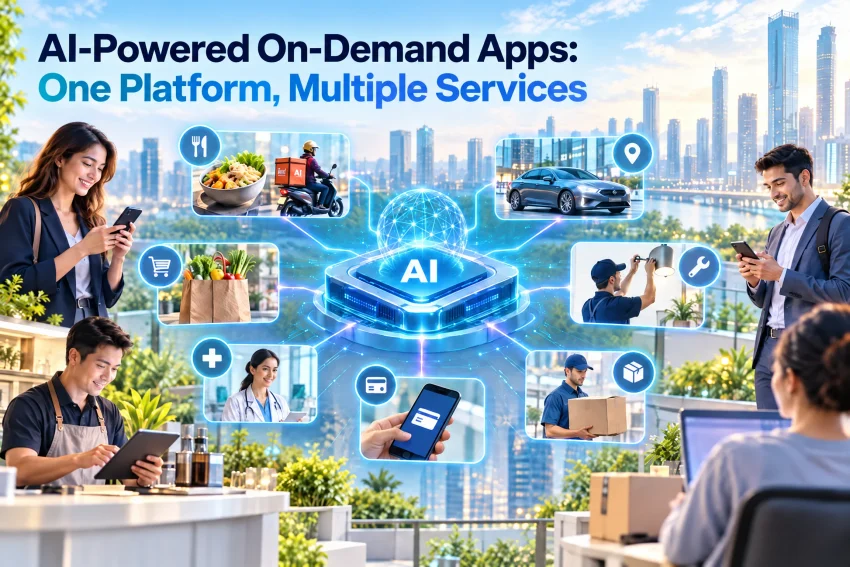
By 2026, many customers feel tired of jumping between separate apps. They want one platform to handle a lot of services. This means booking a ride, getting food, sending a parcel, or hiring a local professional. However, this shift opens doors for owners who plan to build an AI-based on-demand app that covers several services. It can also help run daily work and bring in money by using collected user data.
For businesses, a multi-service on-demand product can fit many types of users. It can also support more than one way to earn revenue. And it can grow over time. The real issue is the build cost in 2026. Another issue is which parts of the app are worth paying for.
Why Multi-Service On-Demand Apps are Growing Fast in 2026?
A multi-service on-demand app lets a company offer several service types in one product. Instead of making separate apps for each need, the business puts them in one app. This can keep users active across different groups. It can also help the business add new monetization paths.
India’s tech scene is a key driver here. The Government of India reports that UPI moved more than 24,161 crore transactions worth ₹314 lakh crore in FY 2025 to 2026. It also says UPI made up about 85% of the total digital payment transaction value in the country.
More people are also using online services as part of routine life. The Government states that around 81% of establishments in India’s unincorporated non-agricultural sector used the internet for business work in the period from January to March 2026. In the same time frame, about 81% of these establishments used cashless transactions.
For someone new to the venture, this means one app will be able to provide a few different services people use daily.
What Is the AI-Powered On-Demand App?
An AI app on demand refers generally to an arrangement where the user can request several services and where artificial intelligence is used to manage some aspects of the process. Moreover, it should make the user experience as convenient as possible and contribute to the business’s growth. One of the ways in which the AI platform for on-demand services is useful is that it can be integrated into various processes at different levels: from the simplest to the most complex.
For example, it can recognize patterns in the demand for services and thereby identify peak hours, and then recommend particular services to users. It can rank companies for specific services and help find the best option, analyze and prevent fraud, and automate responses to frequent requests. In addition, responding to simple queries can be automated. Finally, in the long run, the application may develop into a fully-fledged platform capable of making decisions based on the data it has gathered.
What Service Can You Offer Using One App That Covers Several Other Ones?
A multi-service on-demand application usually focuses on a particular vertical. At the same time, if one is the owner of such a business, one does not have to offer the entire range of services at once. It should begin with one vertical and then expand to others. In other words, if one is considering developing a taxi app, one should not try to add food delivery and other services right away. However, one should understand that the most popular on-demand services include transportation, food and grocery delivery, and the provision of various local services.
A typical example of a multi-service on-demand application is the Gojek clone. It includes transportation services, store delivery, courier services, and several other verticals. Moreover, each of these verticals can be divided into subcategories. However, the main idea is that initially, one should select the services that will be available in the app and then expand the list based on user feedback.
How Can AI Make Your Multi-Service Application More Profitable?
An AI-based on-demand platform can not only help with automating operations but also optimize them and profit from them. However, many entrepreneurs make the mistake of believing that AI is the be-all and end-all of their business and try to implement it everywhere. It is essential to understand that AI must have a purpose, and that purpose should be dictated by the needs of the specific on-demand business.
Here are several ways in which AI can be useful in the work of such an application as a multi-service platform.
Demand Forecasting
According to the data gathered, the machine learning algorithm will be able to forecast the demand for various services and reveal any trends that could be present there. At the same time, it will also be possible to consider other factors such as the location of users and seasonal variation of demand. It will help to forecast the need for certain services and optimize the quantity of drivers or other specialists working for the application.
Smart Matching
Instead of selecting the service provider randomly, the user will be able to find the most appropriate person according to their request, considering such criteria as their location, availability, and special offers. The system will be able to automatically select the best choice, for instance, the closest driver available for a taxi ride.
Pricing Strategy
Taking into account the analysis of demand for various services and supply, the algorithm will be able to establish the optimal price based on the data. Also, the price will depend on such criteria as the distance covered for a taxi ride and other factors. Moreover, it will be possible to implement dynamic pricing rules.
Recommendation of Services and Products
Using the capabilities of an artificial intelligence engine, one will be able to offer the user not only the necessary but also the most convenient and profitable services, including additional ones.
What Features Should an AI-Powered Super App Have?
An AI-Powered Super App is not only about the end-user-facing mobile application. In most of the cases, a Multi-Service On-Demand App requires an end-to-end solution covering customer, provider, delivery partner, merchant, and admin panels within a single ecosystem.
Customer App
The customer application requires authentication, service discovery, booking, payments, tracking, ratings, reviews, wallet, notifications, and order history.
Provider or Driver App
A provider app or a driver app requires users’ authentication, KYC, availability, request management, navigation, earnings, and order history.
Admin Panel
The admin panel will mostly comprise user, provider, service management, rules of commission and pricing, promotions and discounts, dispute resolution, and business analytics.
Which AI Features Are Worth the Investment?
It is important to note at this stage that companies do not need to make use of all the capabilities of AI at once. Usually, at the beginning, an AI-Powered On-Demand Platform needs to concentrate on monetization and operational issues. Some of the AI features worth considering for the MVP include:
- Smart provider/driver matching
- AI-Powered customer support
- Demand forecasting
- Fraud detection and prevention
As the application accumulates sufficient data, you can think about utilizing AI for recommendation engines, customer behaviour analysis, provider churn prediction, and revenue forecasting.
Conclusion
To sum it up, building an AI On-Demand app takes more than plugging several services into one app. You need a solid setup, smart AI parts that solve actual problems, and smooth links between the systems. A Clone App Development Company with relevant experience can assist you in choosing the set of services, describing the feature set of the platform, and defining monetization mechanisms. When done right, your AI On-Demand platform will see sustainable growth after launch and create consistent revenue.
Launching an On-Demand business in 2026 is critical to prioritize services requested by the users and those that generate the highest profits. The Minimum Viable Product should be developed with these services and monetization mechanisms in mind. Next, AI-driven features should be integrated into the application to improve the demand forecast, personalization, and fraud detection capabilities based on the gathered data about the users’ behavior.
Frequently Asked Questions
1. What is an AI-Driven On-Demand App?
An AI-driven on-demand app is an aggregator of services with AI-driven features such as demand forecasting, a recommendation system, and fraud detection that allow users to address their daily life tasks and generate revenue for the business.
2. How much does an AI-Powered Super App cost in 2026?
The cost is determined by the set of services offered, AI features, platforms supported, and technical complexity of the application. In general, apps aggregating multiple services and requiring AI solutions are more expensive than a single-service application. In addition, the cost of custom development of a multi-service on-demand platform and using a PaaS with an established set of services will differ substantially.
3. Can I launch multiple services through one app?
Yes, as the on-demand apps typically aggregate multiple services at once. The initial launch can include taxi, food and grocery delivery, parcel tracking, and home service sectors, but the MVP can also introduce other categories as the business grows.
4. Do I need to use the advanced AI features from day one?
To reduce costs and risks, it is advisable to defer the incorporation of AI within the application to when the business achieves a certain level of maturity. A safer way to introduce AI is to utilize its features within the MVP of a single-service on-demand app, which allows for monetizing the service and using AI to gather insights about the users in order to improve the product.
5. Can the AI-Powered On-Demand Platform be customized?
It depends on the vendor, but the ready-to-deploy AI-Powered On-Demand Platform solution can typically be rebranded and customized in terms of offered services, internal business processes, payment methods, pricing policies, and feature set.