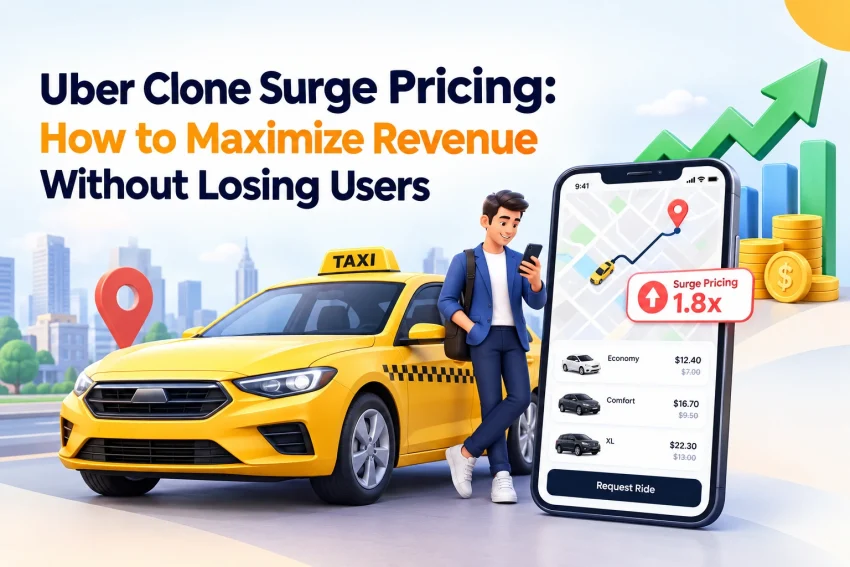
A busy Friday night poses a unique problem for any taxi business: hundreds of people are waiting for a ride, but there are not enough drivers to accommodate everyone. This is where Uber Clone Surge Pricing comes into play and helps the business respond to the rising demand and increase its revenue at the same time.
However, raising the prices every time the demand spikes is not an optimal strategy. If the customers perceive dynamic pricing as unfair, they will be unwilling to pay the increased fares. Instead, a business should use Uber Clone Surge Pricing as an opportunity to implement a demand-driven pricing model and keep the customers informed about the changes.
Surprisingly, Uber itself comments on the possibility of using a dynamic pricing strategy in situations when the supply-demand balance is affected: “Surge pricing happens when rider demand exceeds driver supply, and it encourages more drivers to come online and pick up rides in surge-priced areas.”
What Is Uber Clone Surge Pricing?
Uber Clone Surge Pricing is a system allowing to increase prices for taxi rides in case of rising demand. It is good for business as it can help to balance the supply-demand ratio and motivate drivers to fulfill more orders.
For example, if demand in the business district increases by 500%, growing by an average of 100%, and the number of available drives is 250 out of 500, the best way to meet the demand is to change prices according to their region. However, one should keep in mind that changes should be related to the specific business district and respond to continuous changes in the supply-demand ratio. Thus, it is better not to impose one pricing rule for the whole territory but work with a professional Uber Clone App Development company that will set prices according to changing needs in rides.
How Does Surge Pricing Work in an Uber Clone?
An application would analyze the current supply-demand situation and consider the traffic, location, and other relevant factors. After detecting a situation when supply cannot meet demand, a Ride-hailing App development would be capable of increasing the prices in accordance with the local supply-demand situation. The process would generally involve the following steps.
- Demand increases; supply cannot meet demand
- The pricing engine analyzes the situation
- The prices are adjusted within the area
- Customers are shown the adjusted price
- Drivers are motivated to provide more rides
Furthermore, Uber states that surge pricing differs depending on the area and time and is constantly adjusted throughout the day. Therefore, a Surge Pricing strategy should not be a single universal rule which applies the same percentage increase to the price in all areas. Instead, a Taxi Booking App should be able to detect the demand-supply balance in different regions of a city and adjust the prices accordingly.
Can AI Help Predict Surge Pricing?
Using AI to predict the expected increase in demand allows a business to take measures before a surge happens. This would give the company sufficient time to motivate the drivers and prepare the marketplace to meet the new demand. An Uber Clone App can use both historical booking data and current conditions to forecast the expected increase in demand.
For instance, if the data shows that there is a consistent pattern of high demand in a certain sports bar every Sunday night, the application can adjust the prices in that area before the newly detected demand outweighs the supply. The dynamic pricing feature powered by AI can help a business achieve the following:
- Demand forecasting
- Driver positioning
- Pricing suggestions
- Peak-hour indication
- Event-based demand analysis
- Demand-supply monitoring
Therefore, a Ride-hailing App development company would have an advantage over a traditional taxi business because of its ability to provide dynamic pricing.
How Can You Increase Revenue Without Frustrating Riders?
When increasing revenue through dynamic pricing, a business should adopt the fair pricing practices, which would prevent an abrupt increase in prices. An application can use the approach implemented by Uber, which uses upfront pricing to show customers the expected price for a ride.
This method is beneficial because it informs the customer about the final price of a ride, where the dynamic price changes would be included if applicable. For instance, a Taxi Booking App could show the following pricing suggestion:
Ride cost: $22
High-demand charge: $6
Estimated total: $28
While the actual interface of such an application would be different, the idea remains the same: prevent the customer from being surprised by a dynamically increased price at the end of a ride.
How Can Surge Pricing Help to Attract More Drivers?
One of the main benefits of implementing surge pricing is that it attracts more drivers to provide taxi services. In areas where the demand for transportation services increases, drivers who would not usually provide rides can be motivated to offer their services because they have a chance to make more money. According to Uber, surge pricing helps to promote the idea that more drivers are needed in certain areas to meet the increased demand.
In other words, an increased fare is an effective way to attract new drivers, which would help the business to respond to a demand surge. As the situation stabilizes, the supply would increase, and the prices would return to the regular amount. A Ride-hailing App development company should be able to implement the following demand-supply chain optimization:
- Increased demand
- Higher revenues
- More drivers appear
- Shorter waiting lists
- Higher driver retention rate
- More satisfied customers
- More engaged marketplace
Therefore, it is worth noting that the most important part of the dynamic pricing system is not to increase the revenue at any cost. Rather, the purpose of surge pricing is to optimize the marketplace equilibrium.
What Pricing Management Tools Should Businesses Include?
Administrators of a Ride-hailing App should be able to control the dynamic pricing feature within their application. This would allow them to prevent unexpected situations, when the application increases prices without a reasonable cause. The following tools should be included at the stage of an Uber Clone App Development:
- Minimum and maximum surge
- Zones
- Start and finish conditions
- Dynamic pricing rules
- Driver incentives
- Pricing history
- Monitoring
- Manual intervention
- Automated alerts
As a result, a Taxi App Development Company would create a dynamic pricing engine with a unique combination of control and automation.
Conclusion
A successful taxi business should not only create a user-friendly interface but should also provide fair pricing rates to the customers. A professional Mobile App development agency would be able to add an AI-powered dynamic pricing feature with a custom Uber Clone Surge Pricing strategy, which would be beneficial for the marketplace.
If a business wants to become more profitable, it should use ride-hailing app development to build a dynamic pricing engine, which takes into account a variety of factors before it makes a price adjustment.
Frequently Asked Questions
Q1. Is surge pricing necessary for an Uber Clone?
No, it is not mandatory, as it is more of a business approach. However, it is beneficial for drivers as it helps drivers during times of shortage of supply.
Q2. Can an Uber app-like service use AI for surge pricing?
Yes, this is possible. An Uber clone script can use AI to analyze previous data, detect demand-supply issues, and suggest pricing changes based on marketplace trends.
Q3. How can businesses avoid customer frustration with high prices?
By introducing clear pricing, limiting the surge pricing multiples, providing informative notifications, and using localized adjustments.
Q4. Can surge pricing be applied to certain locations only?
Yes, it is possible. The app can have a pricing engine that allows creating zones and applying dynamic pricing adjustments only when the demand-supply situation in a particular zone requires it.