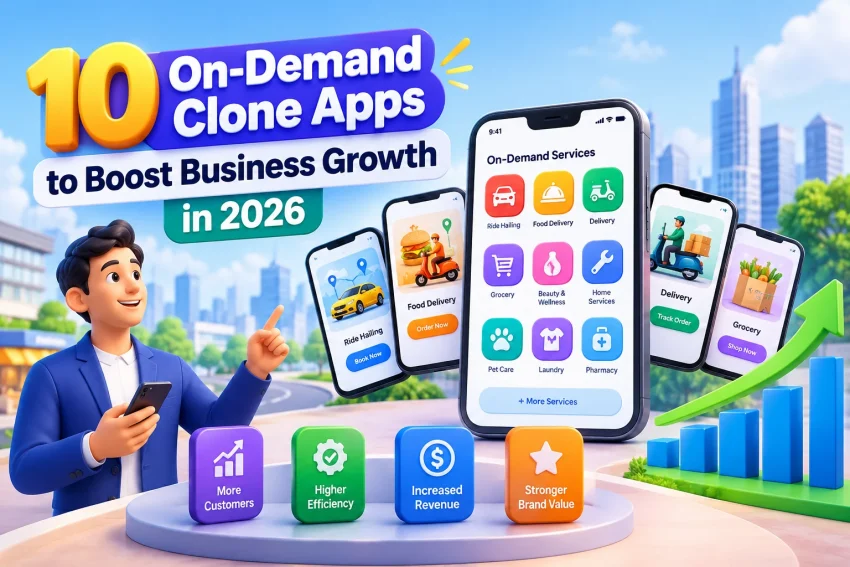
In 2026, businesses are shifting towards quicker, more efficient channels of digital service provision; this is why entrepreneurs are highly interested in on-demand clone apps. Instead of creating a platform from scratch, businesses can get access to a proven app structure and customize it to their target market.
From taxi booking and food delivery to home services and multi-service platforms, a considerable amount of time and cost in app development can be saved using clone solutions. More importantly, the main factor is choosing the right business model, functionalities, and tech partner.
What are On-Demand Clone Apps?
On-demand clone apps are ready-to-customize applications based on successful digital business models. They provide the basic technology needed to connect customers with drivers, delivery workers, stores, professionals, or other service providers.
The term “clone” does not imply fully copying another company. A great solution provides entrepreneurs with a tested framework that they can customize with their own branding, prices, offerings, payment methods, and rules.
Thus, clone application development is a viable possibility for those startups that plan to enter already existing niches but create their own brands.
10 On-Demand Clone Apps to Boost Business Growth in 2026
Number 1. Taxi Booking Clone App
A taxi booking clone is one of the most popular options in the on-demand market. It connects passengers with drivers through a digital platform and can include booking, GPS tracking, fare calculation, payments, ratings, notifications, and driver management.
A modern taxi platform can also support scheduled rides, corporate transportation, rentals, airport transfers, multiple vehicle categories, and other services.
This type of solution can help entrepreneurs launch their Ride-Hailing App in the transportation market because they do not have to implement development from scratch.
Number 2. Food Delivery Clone App
Food delivery is still one of the most significant on-demand business models because customers are growing accustomed to restaurants delivering their meals to their doorstep or workplaces.
A food delivery clone is an app that works with different interfaces for customers, restaurateurs, delivery agents, and administrators. Customers can browse the menu and place their orders, while restaurants oversee the product and delivery workers take care of order fulfillment.
The business can generate revenue through restaurant commissions, delivery charges, customer fees, subscriptions, promotion listings, or other methods.
Food delivery is the most promising model of on-demand business apps, as it can be applied to other types of food delivery, such as grocery, pharmacy, and parcel deliveries, etc.
Number 3. Grocery Delivery Clone App
A grocery delivery platform focuses on helping customers order everyday products without visiting a physical store.
A grocery clone app comes with features such as product catalogs, categories, search options, shopping cart, payments, scheduling deliveries, tracking orders, and managing the store. Businesses can partner with supermarkets, small stores, warehouse companies, and independent retailers.
The platform can also introduce scheduled delivery, subscription programs, promotional offers, and location-based services.
The grocery delivery service tends to become an even more valuable service when merged with other local delivery services with the help of on-demand service apps.
Number 4. Home Services Clone App
Home services create another opportunity for entrepreneurs who want to connect customers with professionals.
The platform can offer services such as cleaning, plumbing, electrical work, appliance repair, painting, pest control, beauty services, or maintenance.
Customers can pick a service, hire a professional, schedule an appointment, determine the payment and obtain a price estimate via the platform. Professionals can organize their appointments and availability of their services as well as manage their earnings and get in touch with their clients.
For businesses, this model can work particularly well in local markets because services can be introduced according to actual demand rather than launching every category at once.
Number 5. Parcel Delivery Clone App
A parcel delivery clone connects customers and businesses with delivery partners who transport packages from one location to another.
The platform can help with pickup requests for any kind of package, delivery addresses, finding a driver for the delivery, live tracking, status of delivery, and digital payment.
Businesses can specifically address the delivery needs of individual customers, online sellers, restaurants, private clients, or corporations. Serving both consumers and commercial customers, a parcel delivery clone could be a good choice for entrepreneurs who are interested in clone apps for business.
The app may also be expanded to other locations by incorporating taxi services or by adding grocery delivery.
Number 6. Beauty and Personal Care Clone App
Beauty services could also shift to an on-demand business model. Instead of customers going to a salon, the platform allows professionals to provide their services right at the customer’s chosen location.
A beauty application can be beneficial to hair stylists, make-up artists, manicurists, specialists in massage, and other providers.
Customers can search for specialists, compare services, set an appointment time, make online payment, and give ratings after the services have been completed.
The model illustrates why on-demand app development is not limited to transportation or delivery. Any type of service related to location, appointments, and availability can become an on-demand service.
Number 7. Laundry and Dry-Cleaning Clone App
The procedure of laundry pickup and delivery is another useful on-demand business model. Customers can schedule a pickup, make service selections, track orders, and receive cleaned laundry items right at their doorsteps.
The business can connect customers with laundry stores or operate its own processing centers. Additional features can include service categories, weight-based pricing, order status, pickup scheduling, delivery tracking, and digital payments.
The laundry platform can provide recurring subscription services for customers who use laundry services regularly.
This goes to show how ready-made clone apps can assist businesses in launching specialized services without going through lengthy and complex software development processes.
Number 8. Pharmacy and Medicine Delivery Clone App
Medicine delivery platforms connect customers with pharmacies and delivery partners. Depending on the market and applicable regulations, the platform can support product catalogs, prescription-related workflows, order management, payments, and delivery tracking.
As the healthcare space has its own legal and operating principles, businesses should check and adhere to the local laws before launching such a platform.
The technology should also prioritize data security and controlled access to customer information.
Entrepreneurs thinking of on-demand app solutions should not forget about adapting software to industry needs and building up-to-date solutions instead of choosing a universal model.
Number 9. Multi-Service Super App
A multi-service application integrates multiple task-oriented categories into one platform. Instead of using a different application for taxi orders, food delivery, grocery deliveries, and services provided at home, it is possible to integrate several services into one.
This model can create several revenue opportunities while giving customers one account, one application, and potentially one payment experience.
Nevertheless, multi-service organizations are more difficult to operate in connection with different providers, pricing structures, and customer expectations.
For this reason, it is necessary to start with several strong categories and grow them rather than trying to operate every possible service from the beginning.
Number 10. Local On-Demand Marketplace Clone
The final model is broader than a single particular service. In fact, some on-demand local marketplaces can gather different independent providers and offer their services via one platform.
For example, an entrepreneur could create a platform focused on the demands of a specific city and provide transportation, food delivery, home services, beauty services, parcel delivery, and shop local services.
This model can be a good option for those businesses that want to create and operate their own on-demand business app instead of depending on only one type of service.
The given approach provides entrepreneurs with the possibility to start with one type of service in one place and gradually add new services according to customer feedback.
What V3Cube Can Offer Beyond Typical Market Solutions
V3Cube’s Gojek solution currently promotes 101+ services and includes multiple panels for customers, providers, stores, administrators, dispatchers, billing, fleets, and corporate operations. It also supports multiple languages and currencies.
Another area that can differentiate the platform is automation. V3Cube provides various features, including dynamic pricing automated by AI, fraud prevention, automatic payment reports, marketing assistance, booking assistance, support for driver income, and monitoring of the platform.
For businesses considering on-demand clone apps, this comprehensive approach may be beneficial for entrepreneurs, as it may begin with one service and then turn it into a bigger multi-faceted technology initiative without having to consider each subsequent service as an additional technological project.
Final Thoughts
The rise of on-demand services is creating opportunities across sectors like transport, delivery, home services, personal grooming, logistics, and local markets.
Entrepreneurs can leverage on-demand clone apps to fast-track their entry into these industries via customizable technological solutions for their business.
The best course of action would be to decide on a solid service, determine the local demand, build a robust network of service providers, and follow a gradual expansion plan from there.
When working alongside an experienced on-demand application development partner, a ready-to-use platform doesn’t merely serve as a quick solution, but can instead serve as the cornerstone of a scalable digital enterprise.
FAQs
Q1. What are On-Demand Clone Apps?
They are customizable applications based on predefined models used in on-demand businesses, thus allowing entrepreneurs to set up applications for different types of services, including transportation, delivery, and home services.
Q2. Can a clone app support multiple services?
Indeed. A multi-service platform can integrate several services into one application, being offered to customers with services ranging from ride-hailing to food delivery.
Q3. Are Ready-Made Clone Apps customizable?
Definitely. The degree of customization depends on the provider. Branding, price, service types, payment systems used, workflow, and other features can be customized.
Q4. Can AI be added to an on-demand platform?
Yes, AI can be used for dynamic pricing, fraud detection, route optimization, reservation assistance, recommendations, reporting, and monitoring of operations, among other things.