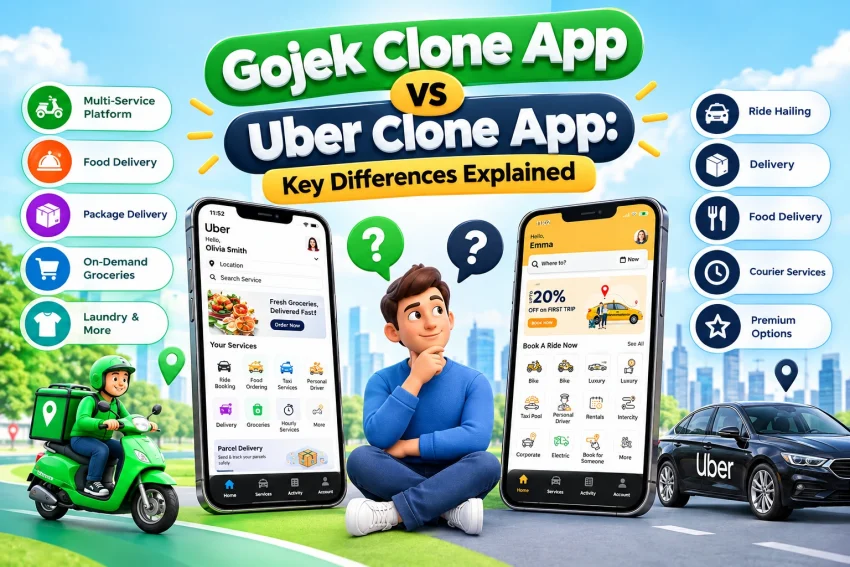
The comparison of Gojek Clone app vs Uber Clone App is important for entrepreneurs entering the on-demand service or transport industry
While both apps are built around different business concepts, but they are able to provide booking, payments, GPS tracking, and customer management.
Uber-style platforms focus primarily on the transportation industry, while Gojek-style platforms combine transport with several additional services.
Knowing these differences will help entrepreneurs choose the optimum technology solution that is tailored to meet their ideas and final goals.
Gojek Clone App vs Uber Clone App: Core Difference
The biggest difference is the business scope.
A Gojek-style platform is designed to become a broader service ecosystem. Transportation can be one part of the application alongside food, delivery, grocery, and home services.
An Uber-style platform generally starts with transportation as its primary service. In addition, extra mobility categories can be applied based on the business
Hence, the selection of the right option will depend on whether the business person desires to create a platform that focuses on transportation or that combines services into a larger ecosystem.
A Real Comparison: Gojek Clone App vs Uber Clone App:
| Business Area | Gojek Clone Model | Grab Clone Model |
| Main Focus | Multiple on-demand services | Transportation and mobility |
| Taxi Booking | Yes | Yes |
| Food Delivery | Can be included | Can be added depending on business model |
| Grocery Delivery | Can be included | Can be customized |
| Parcel Delivery | Supported in multi-service models | Can be add+ed |
| Revenue Source | Multiple service-based revenue streams | Primarily mobility-based revenue stream |
| Expansion Strategy | Broader service ecosystem | Dee[er transportation ecosystem |
| Ideal Business DIrection | Super app | Ride-hailing and mobility platform |
Number of Services
A Gojek-style platform can offer various services. Customers can utilize it to book a taxi, purchase food, send packages, or request home assistance using the same account.
An Uber-style platform generally provides primarily transportation services, but businesses can incorporate different ride options and related services.
For entrepreneurs who are preparing to develop a Multi-Service App, the Gojek model offers a practical avenue to begin with. For companies primarily involved in transport, the Uber model provides a better foundation to start from.
Transportation Features
Both platforms can offer strong transportation functionality. A Gojek like app provides a taxi booking option and offers bicycles, car rental services, business rides, pre-booked transportation, and several other transportation services.
An Uber Like App can also be customized with similar transportation categories. Transportation is the only major business aspect.
An ideal platform must possess functions like GPS tracking in real time, driver matching, calculating fares, navigation of routes, a rating system, electronic payment transfer, cancellation management, and trip history.
Food and Delivery Services
This is another major difference between the two models. A Gojek-style application can combine transportation with food delivery, grocery delivery, parcel delivery, medicine delivery, and local store services.
A delivery service can also be developed through an Uber-like platform, although the business still has to consider whether this kind of service complies with its transportation-focused strategy.
For entrepreneurs who want customers to complete multiple everyday tasks through one application, the broader Gojek model can provide a useful structure.
Customer Experience
The customer journey can also be different. A Gojek application likely showcases multiple service categories on its main screen. Here, a customer can instantly pick their preferred service and therefore book or request it within the same application ecosystem.
An Uber-style application can keep the interface more focused around transportation. Customers can quickly select a pickup point, destination, vehicle type, payment method, and ride.
For a Taxi Booking App, simplicity is particularly important. Adding too many options can make the interface confusing, so businesses should organize services carefully.
Provider Management
A multi-service platform has different types of providers. Taxi drivers need tools for accepting rides and navigating to passengers. Restaurants need order-management tools. Delivery workers need pickup and drop-off information.
Home-service providers may need appointment and scheduling features. An Uber-style platform usually has a simpler provider structure because the main provider is the driver.
This makes the backend requirements different. Super App Development requires a platform capable of managing multiple provider categories without creating unnecessary complexity.
Revenue Opportunities
Although either model can support various sources of revenue, the Gojek approach naturally provides more opportunities for a service-oriented approach. Businesses can get commissions from rides, food, groceries, parcels, home services, etc.
An Uber-style business can generate revenue through ride commissions, booking fees, premium services, rentals, corporate transportation, subscriptions, and other mobility offerings.
The important consideration is not simply the number of revenue streams but whether there is enough demand to support each one.
Business Expansion
The two models provide different expansion paths. A model that begins with an Uber-like business can expand from regular taxi rides to rentals, airport transfers, corporate rides, intercity trips, luxury cars, and various mobility services.
However, a Gojek-style business offers both horizontal and vertical expansion. It can add to the available means of transportation with other types of services, such as food, grocery, delivery, and household services.
Therefore, businesses should consider their long-term growth strategy before selecting the technology structure.
What V3Cube Can Offer Better Than Basic Market Solutions?
Many businesses can purchase basic clone software with common booking and management features. V3Cube’s current solutions go further by providing broader service coverage and AI-powered business tools.
Its Gojek solution currently promotes 101+ services across categories including transportation, delivery, food, home services, and other on-demand services. It also provides multiple panels for users, providers, stores, administrators, dispatchers, billing, fleet management, and corporate operations.
For transportation-focused businesses, V3Cube’s Uber Clone solution includes standard and negotiation-based booking models, scheduled rides, corporate transportation, intercity services, rentals, and other mobility options.
Another differentiator is its use of AI across different operations. Current features include AI-based dynamic pricing, fraud detection, driver earnings assistance, automated payout reports, route optimization, booking assistance, and AI monitoring.
The solutions also support multiple booking channels, including mobile applications, website booking, and WhatsApp-based booking depending on the configuration.
This gives entrepreneurs the flexibility to build either a broader multi-service business or a transportation-focused platform without being restricted to a basic clone structure.
Which Model Fits Your Business?
The choice should begin with your business goal.
If your goal is to come up with a concept that enables users to get various sorts of transport services (ride-hailing), delivery of food or groceries, etc., then the Gojek model would be the most appropriate one.
If you want to create a business that is primarily focused on the transportation industry (taxis), then the Uber model should be used in your project. You can then add additional transportation services as the business grows.
The target market should also influence the decision. A service that works well in one city may not have the same demand in another location.
Final Thoughts
The Gojek Clone App vs Uber Clone App decision comes down to the type of business an entrepreneur wants to build.
A Gojek-style platform serves as a wider basis for a multi-service ecosystem than the Uber-style platform, which focuses primarily on transportation and mobility. The customization and expansion of both types of platforms are possible when backed by the required technology.
Companies must analyze their target audience, initial services, suppliers’ partners, revenue plan, customer service, and future growth plans before launching.
Choosing the platform based on these factors can create a stronger foundation for building a sustainable digital service business.
FAQs
What is the main difference between a Gojek Clone App and an Uber Clone App?
A Gojek Clone Application is developed as a multi-service app, whereas an Uber Clone Application is developed mainly for transportation purposes. Both can be customized with additional services.
Can an Uber Clone App become a multi-service platform?
Yes. An Uber-style platform can be expanded with services such as rentals, corporate transportation, delivery, intercity rides, and other categories depending on the business strategy.
Can a Gojek Clone App be used only for transportation?
Yes. Businesses can launch with selected services rather than activating every category. Transportation can be the initial focus, with other services added later.
Which platform has more revenue opportunities?
A Gojek-style platform can provide more categories for generating revenue because it can combine transportation, delivery, food, grocery, and other services. An Uber-style platform can create multiple revenue streams within transportation.
Can V3Cube customize both Gojek and Uber Clone solutions?
Yes. V3Cube offers both types of solutions that come with customizable service categories as well as business models. Entrepreneurs can benefit from either solution to help them meet their market needs and experience growth.