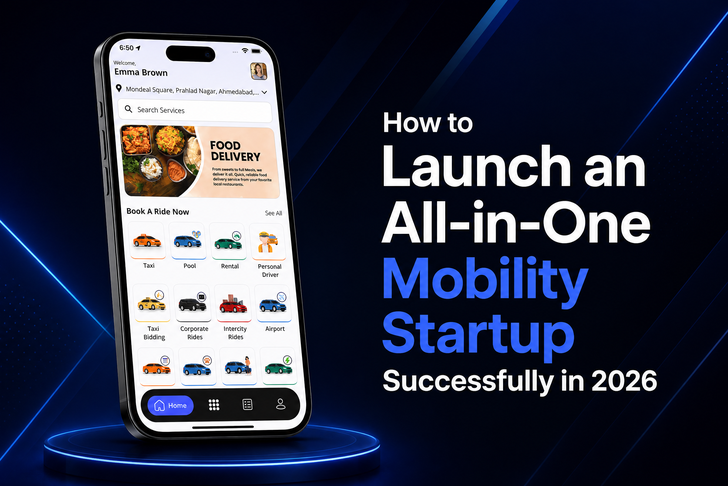
There is a distinct shift towards a more connected mobility ecosystem. India recently launched the Mumbai ONE app that integrates 11 public transport operators. Dubai is also undergoing a massive transformation towards the 2030 vision. Their highly integrated Dubai taxi app integrates taxi booking and the public transport network.
Similarly, mobility apps are shifting towards an all-in-one solution that includes taxi rentals, parcel delivery, taxi pooling, and more.
Consumers also expect more from their mobility apps and prefer a more integrated experience. The global taxi app industry is likely to rise to 468.4 billion by 2033, and super apps are also taking the market by storm.
Hence, if you are a start-up looking to launch an all-in-one mobility app, it is by all means a smart business decision.
This article provides a vital insight into successfully launching an all-in-one mobility solution in 2026.
The All-in-one Mobility App Concept
As the name suggests, this is a single mobile app that combines several transportation and delivery services. It offers users a single app and a single account to access multiple mobility services, such as taxi and food delivery.
More users prefer to use a single app for multiple tasks, which aligns well with this concept. However, the approach may differ depending on the region where you plan to launch your mobility app.
For example, a different set of rules and strategy is necessary for firms targeting European countries like the Netherlands, where there is a popular bicycle culture. But if launching in Africa or Indonesia, a different approach is necessary. One has to deal with poor infrastructure in Africa, high traffic congestion, and alternative taxi vehicle solutions in Indonesia.
Rise of All-in-one Mobility Apps
Ride-hailing isn’t about cars. It’s about confidence that one will arrive. All over the world, people are embracing the digital age for various reasons.
For example, people in Ghana prefer using a mobile app because it is more convenient and beats walking down the lane in the scorching heat. The youth are embracing technology and tend to use taxi apps with smart features to get their job done.
The taxi app market size is expected to rise to USD 254.36 billion in 2026. Using an all-in-one app beats juggling multiple apps and maintaining multiple accounts. It also reduces cognitive overload.
Essential Tips for Start-ups & Enterprises
The all-in-one mobility market is growing rapidly, as indicated by the statistics in the previous section. There are already several popular firms offering services similar to Bolt’s. However, this does not mean the market is saturated. There is plenty of opportunity to build an all-in-one mobility app like Bolt.
Here are a few essential tips to avoid Bolt clone app development mistakes:
- Market research is crucial to the success of your on-demand mobility app.
- A generic taxi app with basic features does not stand a good chance of succeeding in the current market state.
- Each region will require a different approach; hence, although taxi apps are in demand everywhere, the same strategy will not work for cities in Africa and Europe.
- It is important to add AI features, as AI is playing a larger role in user engagement.
- Designing an all-in-one mobility platform means creating an entire ecosystem comprising a customer app, a driver app, and an admin control panel. It may also have several supporting apps and panels.
- Consider regulatory compliance and safety requirements for the region.
Developing an all-in-one mobility app from scratch will require extensive research. It will also involve hiring a software developer to custom-develop the platform. The cost to build a custom all-in-one mobility solution can range from $30,000 to $150,000+. It will also take over 18 months to build.
On the other hand, businesses have an alternative: buying a white-label Bolt Clone app. This is a feature-rich solution with top-notch capabilities that costs much less and can be launched within 2 weeks.
Top Features of All-in-One Mobility Like Bolt
The Bolt app is similar to the taxi booking app Uber; hence, it has similar features, as mentioned below. However, it also provides additional services, making it more similar to the Gojek app.
That said, it is restricted to mobility services and does not offer other on-demand services. The main components include:
Rider App:
This component is meant for users to avail the ride-hailing services and has the following features:
- User authentication
- Ride booking engine
- Real-time tracking with GPS
- Accurate fare estimation
- Multiple payment gateways
- Panic button
- Booking history
Driver app:
The driver app provides drivers a way to utilize the mobility platform. It provides an interactive interface for them to accept jobs and process them:
- Driver dashboard
- Ride requests
- Navigation and route optimization
- Track earnings
- AI heat map
- Subscription plans
Web panel:
This is a website for the mobility platform, and it is an integral part of the overall portal. It offers users access to the booking service and is also a good source of information for all riders, drivers, and service providers.
Admin panel:
The administrator or business owner has full control over the entire portal, and the admin panel makes this possible. It has a highly interactive dashboard that updates in real-time. It allows them to tweak the finer elements of the portal.
- God’s eye view
- Manage all users.
- Manage Advertisements
- Manage promo codes
- Monitor the entire portal
There can be several other sections depending on the type of services offered by the business. These are only the basic features, and to succeed, you will require several other advanced AI-powered features, such as AI-Dispatch, dynamic surge pricing, and more.
FAQ
Which is better, a custom mobility solution or a white-label platform?
The answer to this depends on the nature of the business. A custom solution costs a great deal more and takes over 15 months to build. Hence, this will not suit a firm that wants a fast-to-market solution. A white-label solution costs substantially less and can be ready to launch in 2 weeks.
What is the cost of developing a Bolt clone app?
The cost to develop a custom bolt cone app can range from $30,000 to $150,000 and more. However, the cost of buying a white-label bolt clone app is much lower, and it also takes much less time to launch (2 weeks).
What is an all-in-one mobility app?
An all-in-one mobility app is a transportation app that also includes several other services. It typically includes services like parcel delivery, taxi rental & pooling.
Is an all-in-one mobility app the same as Gojek?
No, an all-in-one mobility app like Bolt is not the same as an all-in-one app like Gojek. Gojek offers a wide range of on-demand services (over 100). On the other hand, an all-in-one mobility app is more about logistics solutions and services, such as taxi booking and parcel delivery.
Bolt to Launch All-in-One Mobility App with a Bolt Clone
Do not miss out on this lucrative opportunity. Rush to buy your bolt clone today! On-demand apps are increasingly popular, and given the industry’s high competitiveness, it is best to launch a white-label clone app.
However, for those with proprietary code or special requirements, there is always the option to hire a bolt clone app development company. For those who prefer a ready-made solution, V3Cube provides a state-of-the-art bolt app clone.
We have delivered over 1900 solutions globally so far and can help you launch your all-in-one mobility solution in 2 weeks. Order your white-label Bolt clone app today.