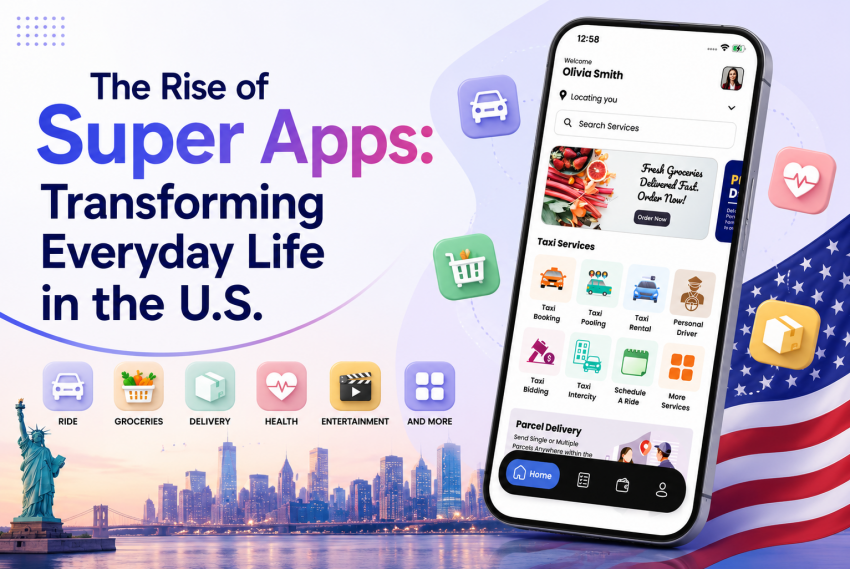
Introduction
USA has always been a country that embraces technology first. Smartphones already empower people to book a taxi, order food, and request common services. Businesses actively focus on delivering a mobile-first experience.
In fact, the on-demand apps are also contributing to the change in lifestyle because if you need a cab, the cab will be at your doorstep in 10 minutes, and if you order food, the food will be delivered in 30 minutes. You need someone to watch your pets; you can have someone in 20 minutes.
How Multi-Service Apps Are Transforming On-Demand Services in the USA
The smartphone penetration in the USA is the highest; it is one of the largest markets in the world, with a value of approximately 105 billion USD in 2025. Hence, it is no big surprise that the future is on-demand.
The changing lifestyle means people need higher-performing and better access to their apps. Besides, consider the busy sporting calendar this year (2026) – FIFA World Cup, F1 GP, USA Open Golf, US Open Tennis, to name a few. From traveling to different venues and juggling daily chores, it is easier for people to use an all-in-one app instead of individual apps.
This article explains the rising interest in multi-service apps in the United States and the business potential.
Global Impact of Multi-Service Apps
The global super app market is likely to rise to USD 155.2 billion in 2026 and 838.3 billion by 2033, growing at a CAGR of 27.2%. However, the main regions contributing to this rise are Southeast Asia, the Middle East, Africa, and South America.
In fact, one of the most popular multi-service apps – Gojek hails from Indonesia, which is now a Decacorn company.
That said, the impact of the super apps is now being felt in other parts of the world as well, like the UK, Europe, and even the USA. A study suggests that the super app market in the UK is on the rise and is projected to reach a value of 32,084.4 million by 2033.
For example, the UK already has its very own super app – ‘Alltap’ that combines food, grocery, and meat delivery, it also includes flowers & fits, parcel pickup & delivery, fashion shopping with local on-demand services on the horizon. Considering the current market conditions, it is ideal to opt for a fast-to-market.
There is also a distinct rise in the demand for super apps in Europe, where people now prefer a single app for everything. USA is not far behind. The market for on-demand apps already exists, and the business opportunity for a multi-service app in the US is high.
Rise in Use of On-Demand Apps in the USA
USA has adapted to on-demand apps in a big way. These apps that connect users to products or services and deliver in real time are on the rise. In fact, the USA is the market with the highest number of online on-demand app users, with over 250 million people.
Some of the popular on-demand apps in the USA include DoorDash, Uber, Uber Eats, Lyft, Instacart, TaskRabbit, and Thumtack. These are used extensively across the country.
Hence, the future is beyond doubt ‘on-demand’. The USA does not have a true super app yet, and the reason for this is the already well-established specialised apps. Besides, there are also privacy and data concerns. However, the obvious question is:
Is the USA ready for a super app?
The evolving lifestyle and behavior of the people suggest that there is high potential for launching a multi-service app like Gojek in the USA.
In fact, the USA already has a few apps that border on being a super app, like:
- PayPal: Direct deposits, bill payments, digital wallet, shopping rewards.
- Uber: Ride-hailing, electric bike/scooter rentals, package delivery, grocery/convenience delivery.
- Walmart: In-store shopping tools, grocery delivery, and financial services.
Cost to Develop a Gojek Clone in the USA
The cost to develop a multi-service app in the United States, like Gojek, largely depends on the development method. Buying a white-label Gojek clone is highly economical and is ideal for businesses looking to enter the USA market, especially start-ups.
On the other hand, businesses also have the option to develop their super app from scratch by hiring a Gojek clone app development company and opting for a custom solution. The cost of such an app would depend on the complexity of the app, the location of the development team, and the type of features.
Businesses can benefit if they order a Gojek Clone app from a well-established firm like V3Cube. V3Cube is a trusted clone app development company that has already launched over 1900 apps worldwide and delivers a super app in 2 weeks.
FAQ
1. Which apps are super apps?
A super app is a mobile app that combines several services in one app. It eliminates the need for users to maintain individual accounts in several apps. Instead of an app with a single codebase, it offers access to all the common services. For example, the Gojek app offers access to a wide range of on-demand services like ride-hailing, food delivery, requesting a babysitter, locksmith, plumber, car repair, and much more.
2. What is the fastest method to launch a multi-service app?
There are two main methods to build a multi-service app. One is to engage in custom development from scratch; however, this can take up to 18 months or more and also cost more. The faster method is to buy a white-label Gojek Clone App. This type of app can be customized and ready to deliver within 2 weeks.
3. Whatare the benefits of super app development in the USA?
In a country with the highest number of on-demand app users, the one thing that people will appreciate is an all-in-one that allows them to integrate all their services in one app. It is the ideal app to deal with people combating ‘app fatigue’ from juggling several on-demand apps daily. It is a good business opportunity for firms looking for their next big business venture.
4. Which industries can benefit from a super app like Gojek?
The Gojek-like app is popular in the taxi and food delivery industries. However, it is suitable for a wide range of on-demand industries. Some of the main industries one can leverage a super app for include transportation, education, home services, beauty & wellness, healthcare, food delivery, logistics, and retail.