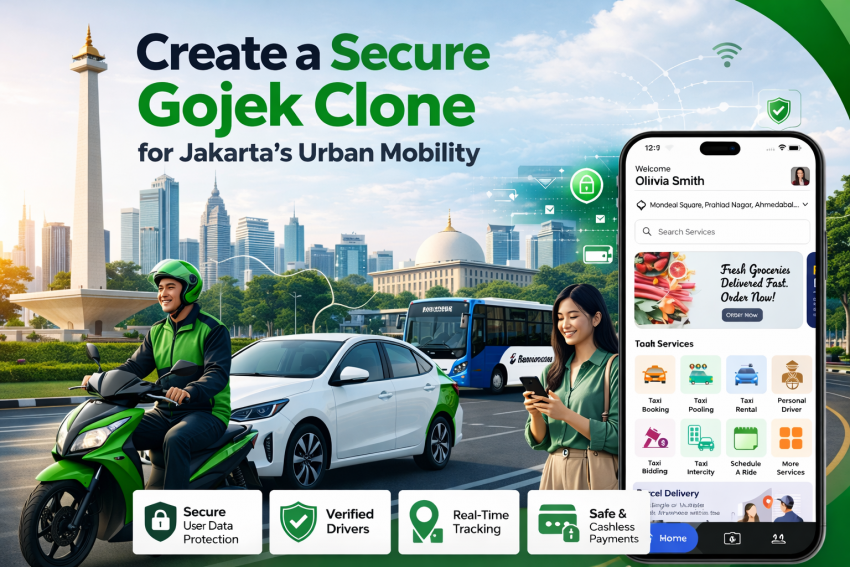
Jakarta has a rapid pace, but women must consider safety first prior to thinking about convenience. That’s the reason why a Gojek Clone in Jakarta cannot be constructed as a basic ride application. It must protect passengers all the way through the trip from pickup to drop-off because trust is the main value here.
Women’s Safety Concerns Across Jakarta
In Indonesia, the level of female violence is not small. Komnas Perempuan reported 330,097 incidents in 2024, an increase of 14.17 per cent over the previous year and demonstrates how severe the issue is across the country. In Jakarta, the issue of mobility gets more severe since women are also faced with unsafe commutes, overcrowded public transportation and the risk of harassment.
Jakarta’s commute problems are not only about traffic. Women are more at risk at night, particularly in areas that are less crowded. Public transportation is not often made with women’s safety in mind. An Indonesia-focused study found that women fear the possibility of assault, harassment and overcrowding, as well as long lines and the old infrastructure that makes travelling far more stressful than it ought to be.
One of the figures from the Jakarta publication states that 94 per cent of women living who reside in Jakarta have suffered physical or sexual abuse while on public transport. This isn’t a minor gap within the existing system. This is the system screaming for a redesign.
How Does Gojek Tackle This?
Gojek has taken steps in the right direction to improve its safety, and that’s what matters. The safety system currently in place includes an emergency Button, Share Trip, screening and training for drivers, trip monitoring and 24/7 customer support, as well as data security and trip rating. The company also provides on-trip accident insurance, which provides an additional layer of security for its users.
The most impressive thing is that Gojek does not view safety as a single feature. It integrates protection and live tracking, as well as assistance and feedback after the trip. For instance, users are able to communicate route information as well as driver information and their ETA with family members, and the app keeps track of the speed of pickup, drop-off and the route used.
There are however, insufficient coverage. For instance, the Emergency Button is available for GoCar across Indonesia and GoRide only in Jabodetabek. This means that coverage isn’t the same across all regions and services. In addition, many of the safety tools offered by Gojek are ride-based or reactive. They aid during the journey; however, they don’t entirely solve the problem of women feeling insecure before even entering the vehicle, nor after they have left the vehicle. This is the most dangerous danger zone.
Jakarta is working on a response at the city level as well. DKI Jakarta has SAPA complaint posts that work with TransJakarta MRT and LRT points. Officers have been assigned to 23 TransJakarta stations and thirteen MRT stations, as well as 6 LRT stations. It’s a good thing, but it also proves that safety requires a better, more connected system.
How a Safety-first Gojek Clone Can Save the Day
A security-first Gojek Clone in Jakarta can succeed because it can solve the local issue. Jakarta customers do not need a less expensive ride. They are looking for a ride that is secure, visible and easy to take action when they feel something isn’t right. In the city where safety concerns influence travel decisions, this isn’t an option. That’s the way it is.
This is why many applications that clone themselves are failing. They mimic the booking flow and ignore the emotional experience. Women don’t imagine, “Nice, the app does what it says.” She considers, “Will this driver match be secure? Can someone track me? Do I have help quickly in case the route is changed?” A good clone will answer these questions prior to when the user is able to ask them. Human beings, in general, need to feel secure before being amazed.
A clone that is strong should be based on trust signals. It should indicate who is responsible for picking up the passenger, where the vehicle is heading, how to notify to help, and what ways the family member or a friend can follow the entire journey. The information should be local enough to Jakarta since safety behaviour in Jakarta is influenced by traffic congestion, late-night activity, traffic jams, crowded streets and last-mile travel.
Safety Features in Gojek Clone
A safe-first Gojek clone shouldn’t hide safety behind the settings menu. It should put it at the top of the screen, where the real decision-making takes place. The following aspects are crucial for Jakarta:
- Real-time trip sharing, so an individual with whom you trust can track the trip.
- An emergency help button that offers one-tap assistance.
- Identification of the driver with an identification or a license, and also vehicle checks.
- Live route monitoring helps to identify incorrect turns or lengthy delays.
- In-app rating and incident report following each visit.
- Protection or on-trip insurance.
- 24/7 support is available to answer your questions promptly, not waiting until tomorrow morning.
These functions are effective because they encompass the complete journey. Prior to the ride, passengers are able to view the driver’s and vehicle information. During the ride, they can discuss the ride and issue an alert. Following the trip, riders are able to evaluate, share their experiences and receive assistance. This is the ideal shape to build confidence. It’s easy to see and difficult to falsify.
For Jakarta, two extra layers matter even more. First, the app must allow women-friendly pickup spots particularly near the busy roads, transit stops and night-time areas. In addition, it should support the use of low-friction, quiet reporting because a lot of people don’t wish to tackle forms if they’re scared. The most secure feature is one that you can get tired of using in just ten minutes. This is normal sense, and that’s why it a rare.
White-Label vs Custom App: Who Wins in Jakarta?
White-label is the preferred choice in Jakarta for the majority of companies because it’s quicker to go live, more affordable and able to adjust to local needs. In a marketplace where time is a factor and trust needs to be established quickly, using a white-label Gojek Clone in Jakarta gives firms a base of security features, booking processes and branding that is already in place. Customising apps is only appropriate when a company has an enormous budget, a long runway, and very specific operational requirements.
White-label is the best option for those who want to be able to get into the market quickly and verify demand without wasting time or money. It also allows for essential safety features such as the ability to share trips, emergency assistance, driver verification and assistance with local dialects. This is sufficient for the majority of operators looking to provide Jakarta efficiently without starting with a blank slate, like the ones who enjoy having to suffer for sport.
Customised apps can provide more control, but it’s only effective if you are able to pay for the time and the cost. For the majority of businesses located in Jakarta white-label provides the most balance between speed, security and readiness for launch. It lets you enter the market earlier and with fewer risks, and products that still feel safe and local.
Conclusion
Jakarta requires ride-sharing apps which do more than just move people from one location to another. The safety concerns of women as well as commute stress and the risk of harassment are real and the evidence can’t be ignored. Gojek has already created a number of helpful safety tools, but there’s a need for a more robust, local product that is more aware of women.
This is an opportunity for an improved product. A Gojek Clone in Jakarta can be notable if it takes safety as a primary factor and not as a secondary feature. Build to build trust, build for rapid assistance, as well as build to meet the local needs of travellers and for women who shouldn’t have to decide between moving and being secure.