Executive Summary
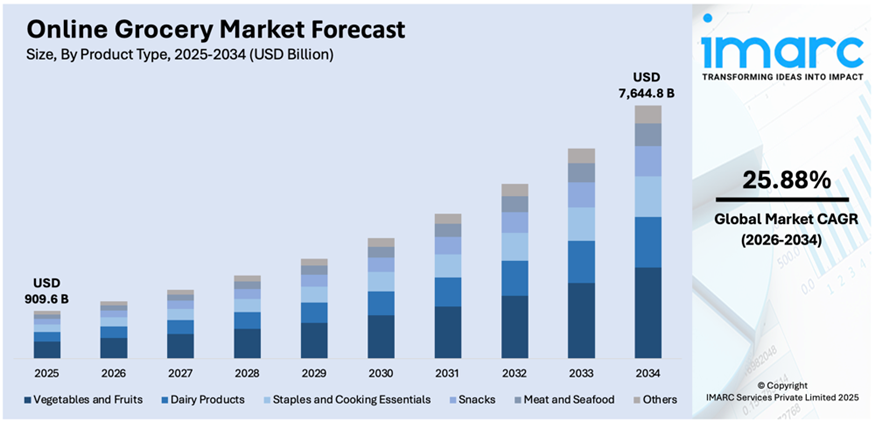
The global online grocery market is booming and forecasted to reach over $1 trillion by 2026 because people worldwide use smartphones, which now have an ownership rate of 82 percent, and they prefer convenient shopping solutions. Entrepreneurs who create grocery shopping applications can use this business model to access a rapidly growing market, which provides them with steady income from customers and valuable information about their target audience. The white-label solution provides an efficient solution because it delivers a complete application system, which requires only branding to become operational within weeks, instead of spending four to six months to build custom software solutions, which would incur higher expenses. The guide includes information about market conditions and essential product elements, together with revenue generation methods, marketing entry strategies, and a demonstration project timetable. The document helps you design a grocery application which will operate from its launch through its growth period as a white-label solution, with two weeks required for its operational deployment.
Market Context and Trends[A1]
Key Stats: The online grocery sector is one of e-commerce’s fastest-growing segments. Online grocery sales now make up 10 to 15% of total grocery sales in developed markets. For example, nearly one-third of U.S. households now order groceries monthly via apps. The industry will experience growth between 20 and 30 percent until the end of the 2020s. The emerging markets of Southeast Asia, Latin America, and Africa present a major opportunity for startups because their online grocery market remains underdeveloped, yet consumer interest is increasing.
Entrepreneurial Value Proposition
The combination of grocery apps with customer engagement measurement through their business model, which earns recurring revenue, creates an ideal opportunity for entrepreneurs. The shopping patterns of grocery customers create a steady shopping rhythm, which results in customers buying specific amounts of products during their shopping trips at regular intervals. The app generates greater value from each user because it increases their lifetime value to the business. The food shopping app fulfills a common requirement, which results in high customer retention rates and network effects through user referrals.
Founders find two additional reasons to start their business through the grocery app, which provides them with data insights about customer preferences and data insights about brand usage. A grocery app gathers rich data on purchase habits, enabling personalization and inventory optimization (AI-driven recommendations can boost revenue up to 40%). The platform enables direct shopper connections, which stay closer to customers than large retailer sales channels. The grocery delivery business experiences constant demand throughout the year because people need to buy food, which makes this business model more robust against economic downturns than most on-demand delivery services.
Time-to-market operates as the most important factor for product development. The market experiences rapid growth because major companies such as Instacart and Amazon, and local chains keep developing new products. Entrepreneurs should aim to launch quickly and iterate. White-label app platforms excel here: they provide a tested, full-featured grocery app that can be branded for your business in days/weeks rather than building from scratch. The system allows you to begin customer service while generating income right after installation, which happens much faster than the time required for a custom product development, which takes several months.
Core Features & Tech Stack
A modern grocery app must include these core components:
User Experience:
The product catalog creates an intuitive user interface which enables customers to search products using category browsing and filters, and a smart search function. The system requires users to display their items using high-quality images and detailed item descriptions.
Cart & Order Flow:
The system requires users to maintain their shopping cart throughout their shopping session, which allows them to change product quantities before they complete their purchase with a single button click. The system needs to conduct inventory updates in real time to stop customers from placing orders that include out-of-stock products.
Payment Integration:
The secure checkout process supports multiple payment methods, which include credit and debit cards and mobile wallets such as Apple Pay and Google Pay, and local electronic payment solutions, which include M-Pesa and Paytm. The system needs to ensure all transaction processes maintain PCI compliance while using encrypted data protection.
Delivery & Logistics:
Users can either enter their address details or select the pickup option. The system supports GPS and map services, which include Google Maps and Mapbox, to create routes and track drivers in real time. Users have the choice to receive their items immediately or choose a specific time for delivery or pickup. The system provides an API connection to external courier networks for use during crowdsourced delivery situations.
Merchant Dashboard:
The admin panel enables store owners to control their entire store operations, which include product management and price setting, inventory control, order processing, and performance tracking. The system needs to support bulk product uploads through CSV and ERP synchronization while processing customer orders.
Scalability & Security:
The system needs to use cloud services, which include AWS, GCP, and Azure, to support its demand-based expansion. The system needs to secure all backend processes, which include Node.js, Python and Java services.
Monetization Models & Unit Economics
Grocery apps typically combine several revenue streams. Common models include:
| Earn revenue through partnerships (e.g., a bundled offering with another service) or affiliate marketing (recommend products/services for a cut). | Description |
| Commission | Take a percentage (e.g. 5–20%) of each order’s value from merchants. Many grocery apps operate on a marketplace model, earning a commission on items sold. |
| Delivery Fees | Charge customers a flat or distance-based delivery fee. Could be waived above a basket size or for premium subscribers. |
| Subscriptions | Offer a paid membership (e.g. $9.99/mo.) for perks like free unlimited deliveries (similar to Amazon Prime grocery benefit). This encourages loyalty and upfront revenue. |
| Advertising/Promotions | Sell in-app ad space or sponsored listings to brands/CPGs. For example, featured products or banner ads, which can be lucrative given the targeted audience. |
| Referral/Promos | Earn revenue through partnerships (e.g. a bundled offering with another service) or affiliate marketing (recommend products/services for a cut). |
| Data/Analytics | (More advanced) Sell aggregate customer trends or insights to CPG brands, though privacy laws must be respected. |
The business value of your models depends on their effect on unit economic performance. The main measurement tools include Customer Acquisition Cost (CAC), Customer Lifetime Value (LTV), and Gross Margin per Order. Grocery stores need to maintain their profitability through both operational scale and regular customer visits because their business rest on their ability to sell perishables at low profit margins. A 10% commission on a $50 basket results in $5 gross revenue, which needs to cover all delivery and fulfillment expenses. The majority of applications charge delivery fees or require users to pay subscription costs as a way to recover expenses. The organization needs to use efficient logistics operations, which include order clustering and route optimization, to achieve delivery costs that remain significantly lower than their gross earnings.
Regulatory, Data Privacy, and Logistics Considerations
Food Safety & Compliance:
Different regions establish specific guidelines for transporting perishables because they require different methods of handling such goods. The handling of refrigerated and frozen products requires you to obtain necessary permits or certificates. The sale of products such as alcohol, baby formula, and pharmaceuticals requires businesses to implement age verification systems and obtain special licenses.
Data Privacy:
Organizations must fulfill requirements established by GDPR (Europe) and CCPA (California) laws. Organizations should collect only required information while using encryption for both data transmission and storage, and creating understandable privacy policies. Marketing messages require organizations to obtain explicit consent from their audience. Organizations handling payment information need to follow PCI DSS regulations.
Payment Regulations:
Your organization must follow e-money and fintech regulations if it keeps customer funds in wallets or connects to local payment systems (for example, PSD2 in the EU and e-Money licensing requirements).
Logistics & Delivery:
Organizations need to create solutions for their last-mile delivery problems. The cold chain system needs to deliver complete reliability for handling frozen and fresh products. Organizations need to monitor their delivery routes and enhance them because they must achieve high on-time delivery rates, which customers expect for their grocery orders, Organizations need to choose between three options for delivery drivers based on their business size: in-house drivers, crowdsourced riders, or partnerships with delivery companies. Organizations need to consider insurance costs along with liability issues that arise from accidents and damaged goods.
Labor & Gig Economy Laws:
Delivery services using gig workers needs to comply with local contractor regulations because some jurisdictions treat gig workers as employees. The business needs to deliver clear job policies along with competitive pay rates to protect itself against potential legal actions.
Taxes & Local Laws:
Your business and application need to follow correct registration procedures in every market where you operate. You need to collect and pay sales tax or GST for grocery sales according to applicable regulations. Your application needs to consider cross-border challenges if it operates in different countries because of diverse currencies and languages, and local consumer protection regulations.
Organizations that address data and security issues alongside logistics challenges at their initial planning stage create trust with regulatory agencies.
Real-World Examples
The potential and market approaches of different markets become evident through multiple applications, which demonstrate their capabilities.
- Instacart (USA/Canada): create grocery shopping applications. Instacart partners with approximately 1800 retailers who operate almost 100000 stores throughout North America. The platform handles more than 25 million users who create around 1.5 billion orders every year. The scale of Instacart operations enabled them to reach 98 percent of United States households. The company implements a marketplace system which includes both commission-based and subscription-based revenue streams.
- Amazon Fresh / Whole Foods (USA/Global): Amazon’s grocery arm. Amazon provides its app users access to fresh groceries and essential items, which it delivers to more than 3500 cities. The service provides Prime members with complimentary delivery when their orders exceed $35. Amazon’s grocery business, which includes Whole Foods, generated multiple billion-dollar sales throughout 2024. Amazon competes strongly because of its extensive scale and connection to its entire platform.
- Rappi (Latin America): A Latin-American “everything app” (Colombia-based) covering multiple countries. The platform currently has more than 30 million active users who operate in more than 9 different countries. Users can order groceries, meals, pharmacy items, and other products, which they receive through expedited delivery services. Rappi operates a fintech division which issues credit cards and invests extensively in artificial intelligence to develop logistics systems.
The examples provide distinct methods to operate digital grocery business through their selection between marketplace and direct fulfillment methods, their choice of subscription and ultra-fast delivery and Omni-channel retail, and their desire to deliver digital grocery products to customers. The majority of companies began their operations in one city before expanding their services to additional regions after they established their business model.