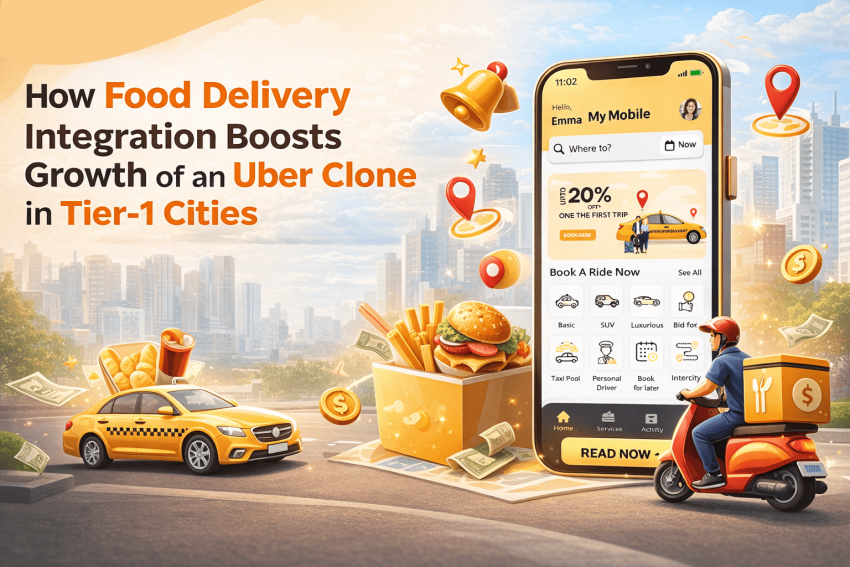
Tier 1 Markets: The Real Test for Uber Clone
Do you know how many Taxi Apps has a metropolitan city seen? In every market, there are tiers which define how economic acceptance and how things work in that specific region. Many products including every tech product ever, are mostly designed to enter Tier 1 market first. Uber Clone is no exception. Every entrepreneur starts from a Tier 1 market today. Many see this as the only way to rise and generate sustainable market share, but the reality today is much different. The giants like Uber, Ola, bolt, Didi, Lyft, etc. are already penetrating the tier 1 markets deeply, and most people fail to understand this, and eventually shut their app down.
In this blog, you’ll learn a specific way to get out of this generic pattern with a little twist. Capturing a sustainable market in tier 1 becomes easy with adding food delivery segment in your taxi app. This blog gives you a complete understanding to the market dynamics and provides a closure to this quote—every taxi app fails in deeply captured markets!
A little Newsflash about Uber Clones
Uber Clone is a proactive choice for every founder who wants to launch their own taxi app in 2026. As Uber Clone is a pre-built solution provided by a white-label firm, the idea of developing, launching, and deploying apps is no longer a gamble that takes years to unfold.
An Uber Clone truly benefits to these following people:
- A Taxi fleet owner who’s trying to build their own taxi app to grow their business.
- A government franchise trying to regulate the taxi app against global monopoly.
- An independent entrepreneur who wants to launch an online business that connects taxis and users.
If you’re any of them, it’s a perfect choice for you. Now, how to develop is already a solved problem. And this is why, tier 1 markets are filled with generic taxi apps. If you really want to grow out and be unique, it’s high time you should add Food Delivery.
Why Food Delivery in Uber Clone Can Set You Out of The Crowd?
Launching a Taxi App is a known idea, and the market rarely finds any gap in most regions. So, today, adding a Food Delivery Section in Uber Clone completely makes sense. It does 3 major things for the taxi app which becomes instantly much more profitable and sustainable.
New Revenue Model
Launching a segment which already has more business revenue streams is nothing but a true moment of happiness that comes along at a very economical investment.
New Market Gaps
The Food Deliver Segment still faces a lot of Gaps across the globe due to several things. Most prominently, it’s the discount codes, the high commission rates, and most importantly, the price sensitive markets. These problems are still faced by every delivery driver, every restaurants, and on top of it, restaurants have to invest in inventory management softwares. These market gaps are still prevalent because of single revenue stream system.
The Super App Fallacy
The Super App Fallacy means only a single thing. Many people have seen a major shift from single service apps to super apps because of one issue, App fatigue. Thus, you can become a super app model with the food delivery segment and earn the trust of user.
How Does the Taxi + Food Delivery Model Exist?
The taxi app and food delivery app can co-exist because of the categorization of the model. Today, people want to search fast, get things faster, and the model exactly taps into that pain-point. With categorization and advanced search features the model works wonderfully accepting more users, more drivers, and restaurants who truly want the convenience of online business.
Features that Empower Uber Clone: Food Delivery + Taxi Model
So far, you’ve invested your time into understand why this model works. Now, let’s get the piece of the cake. The features which can help in gaining a successful operation in tier 1 markets are as follows:
For Taxi:
- AI Powered WhatsApp Chatbot
- Fleet Company Web Panel
- Stop/Shop/Eat While Riding
- Airport Rides
- Multiple Stop over Points
- End-of-the-day trip
For Food Delivery:
- Multiple Deliveries in One Trip
- Contact-Less Deliveries
- Inventory Management
- KOT Printing
- SKU Codes for Delivery Items
General Features (Working in both):
- In-App Wallet
- Earnings Report
- God’s Eye View
- Smart Login
- AI-Powered Dynamic Pricing
- Facebook and Google Ads Integration
Cost Vs ROI of Adding Food Delivery in Uber Clone
Food delivery segment can be added easily in the Uber Clone if you launch with a white-label firm. While many prefer custom development, it’s much more costly and takes time. This is why white-label firms are the best tech partners.
To understand how much an Uber Clone with Food Delivery Costs you need to understand how the costs are determined.
Cost Parameters
The Cost parameters are no longer the billable hours. Unlike traditional development, in white-label firms the tech stack you prefer, the features you want, and the design you choose makes the impact. To an average, a Taxi + Food Delivery App, developed by a white-label firm can cost you much economical over custom development because it uses native development which is robust for scaling, timelines are minimized, and there’s no hiring cost included to what you pay.
ROI: The Powerful 6 Stream Revenue Model
The Revenue Model of the Uber Clone with Food Delivery is setup in a much wholistic way to ensure that the platform can earn good value and profits while not exploiting any segments like user, driver, or restaurant. The commissions exists, however, to ensure you earn more while charging less commissions the Taxi + Food Delivery module has 6 streams in total which provide absolute revenue maximization. They’re as follows:
- Commissions
1.1 Convenience Fees Charged to user
1.2 Commissions Charged to Restaurants on Every Completed Order - Priority Listing Fees
- In-App Third Party Ads
- In-App Subscription Fees
- Surge Pricing
- Cancellation Fee
These 6 Revenue Models are included in an Uber Clone with Food Delivery. This module is designed to earn its maximum potential if you take care of user behavior with utmost priority.
Regulatory Compliance: What Most Founders Forget
By adding food delivery to your app, one precaution arises, and it’s necessary. For most people who have no knowledge of local laws, having to do regulatory compliance often becomes ignored and regretted when hit like a silent truck.
Thus, ensuring that regulatory compliance stays on your checklist is the best way because prevention is always better than cure. Here’s a simple checklist to follow if you want to achieve basic Regulatory compliance without any hassle.
Food Safety & Kitchen Licensing
Ensure every partnered restaurant holds a valid food-safety license (FSSAI or local equivalent). Require periodic kitchen audits, digital photo evidence, and a signed food-safety SLA before onboarding.
Business Registration, Tax, & Invoicing
Register the platform entity for GST/VAT and enable compliant invoicing. Configure tax collection rules per state/municipality and keep a tax-audit folder for merchant invoices.
Delivery & Liability Insurance
Maintain commercial general liability + courier/delivery insurance covering third-party injury, food spoilage, and property damage. Require minimum vehicle/health insurance proof from couriers.
Driver/Courier Labor Compliance and Vetting
Run KYC, background checks, and maintain signed contractor agreements. Track worker classification (gig vs employee) per local law and keep payroll/earning records for audits.
Payment, Data Safety, & Consumer Protection
Use PCI-DSS compliant payment processors, secure PII with encryption, publish a GDPR/PDP-compliant privacy policy, and implement easy refund/complaint workflows.
Local Municipal & Food-Specific Rules
Verify local permits (street vending, delivery zones, and waste disposal rules) and set packaging/labelling standards (allergen info, expiry, and refrigeration instructions). Maintain a simple “compliance checklist” per city before go-live.
Conclusion
Launching an Uber Clone in Tier 1 city is costly and slow. Many people just fail due to generic taxi apps and no uniqueness in their app. With the shifting demand towards super apps, it’s better to launch your Uber Clone with Food Delivery Module. With this, your taxi app ROI increases in comparison to the older generic taxi module. This is where you need to keep an eye. The cost to launch Taxi + Food Delivery App is very economic and the returns are much better with white-label Uber Clone solution. If you’re deeply interested, it’s high time you should invest in an Uber Clone today. Check out the live demo and start your journey to launch your own Taxi + Food Delivery App today.