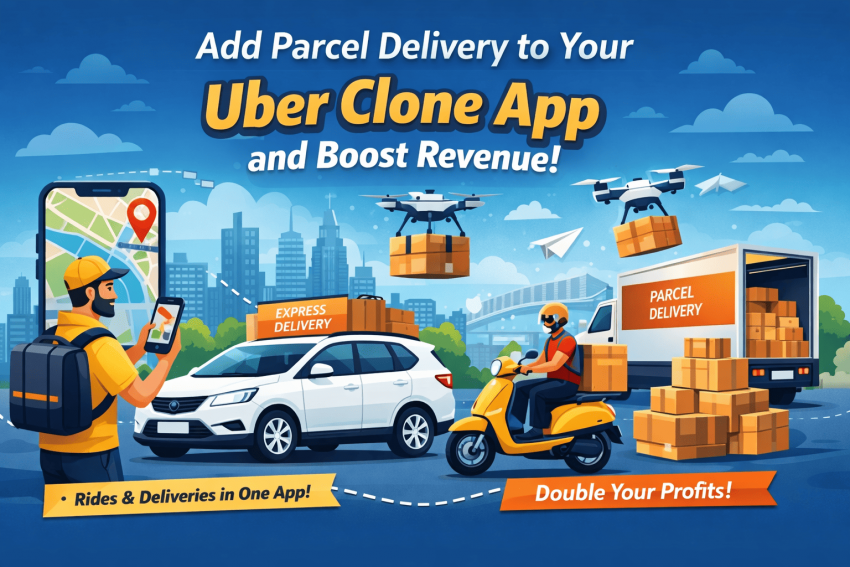
Taxi apps have changed how people move, and now they are changing how goods move too. From Lagos to Las Vegas, from New Delhi to New Zealand, ride-hailing platforms are evolving into Super Service Apps. In 2026, the biggest shift is obvious: founders are turning single service taxi apps into ride-and-delivery ecosystems. The most requested upgrade? Parcel delivery.
Adding parcel delivery to an existing platform is not a gimmick. It is a logical, revenue-first step that brings higher utilization, better driver earnings, and more value for corporate and retail customers. This blog explains why parcel delivery matters, how an Uber Clone Parcel Delivery app works, what changes in the UI and UX, and how B2B customers can roll it out with confidence.
Why Parcel Delivery Lifts the Taxi App’s Business Model
A taxi app runs on two core assets: active users and available drivers. Parcel delivery increases the utilization of both, and it creates new revenue without doubling infrastructure.
Key business reasons to add parcel delivery to an Uber clone:
- More Orders for Drivers. Drivers get paid for extra kilometres that would otherwise be deadhead trips.
- New Revenue Streams. Delivery fees, priority delivery, insurance add-ons, and B2B contracts diversify income.
- Increased customer Loyalty. Users prefer a single app for both moving people and moving things.
- Similar to Taxi Model. The same dispatch, routing, and payment systems can handle both services with small tweaks.
- Unique Selling Point. A Ride and delivery app becomes a local super app, capturing both urban mobility and last-mile logistics demand.
For B2B decision makers, that translates into better unit economics, faster path to profitability, and a clearer product-market fit in the on-demand niche.
What “Uber Clone Parcel Delivery” Really Means
When the phrase Uber clone parcel delivery shows up in a product roadmap, it should mean more than adding a “send parcel” button. It means integrating a tested delivery workflow into an existing ride-hailing backbone, while keeping brand control and ownership of data.
A well-built Uber clone parcel delivery module includes:
- Sender and receiver flows in the rider app
- Delivery driver workflows (pickup, transit, proof of delivery)
- Admin dashboards for tracking and reconciliation
- Pricing logic for distance, weight, urgency, and insurance
- Clear reporting for B2B customers and integrations with business ERPs
The goal is to launch a delivery feature quickly, while maintaining the same reliability and design language users expect from the core taxi product.
Parcels on the Move: User Flow
The parcel delivery flow must be simple and fast. A clean user journey reduces call centre volumes and increases repeat orders.
Typical parcel delivery flow:
- Sender opens the app and chooses “Send parcel.”
- Sender enters pickup and drop-off addresses, parcel size or weight band, and preferred delivery speed.
- The platform assigns a nearby delivery driver based on load, route, and driver preferences.
- The delivery person takes the parcel, either scans or takes a photo for documentation, and changes the status to picked up.
- The driver takes the parcel to the recipient, collects proof of delivery (photo, OTP, signature of the recipient), and finally, he/she/they concludes the entire route.
- The payment gets through card, e-wallet, or cash on delivery methods, with invoices and tracking accessible to both the sender and the receiver.
This sequence mirrors ride booking logic, which keeps engineering overhead low. The difference lies in additional checks, packaging categories, and delivery-specific options.
UI And UX Changes When Adding Parcel Delivery
Design changes must be intuitive. The goal is to add functionality without cluttering the core ride experience.
Key UI/UX updates:
- Clear categorization. Add a dedicated “Ride” and “Delivery” toggle on the home screen to avoid confusion.
- Quick parcel presets. Small, medium, large templates with suggested packing tips shorten booking time.
- Dashboard upgrade. Drivers get a consolidated dashboard showing current ride, pending deliveries, and earnings.
- Proof of delivery UI. Simple camera interface for photos, OTP entry, or digital signature capture.
- Tracking and ETA. Live tracking for both sender and receiver with delivery progress markers.
- Admin panels. New filters for parcel status, insurance claims, and batch scheduling for corporate clients.
These changes must be mobile-first, low-friction, and optimized for quick taps. For B2B clients, add API endpoints for bulk orders and enterprise reporting.
Who Benefits & How
Adding parcel delivery creates wins across the board.
- Entrepreneurs and small businesses
Small merchants and local sellers gain an easy, on-demand delivery channel. They can send same-day parcels, manage returns, and get invoices for accounting. Subscription plans for frequent shippers make the offering very cost-effective. - Drivers
Completing deliveries in the periods between passenger trips enables drivers to earn more. Flexible pickup regulations allow drivers to accept or decline delivery requests according to their vehicle size and route. Delivery boosts average earnings and reduces idle time. - End users
Customers get more value from one app. A user can ride to a destination and send a parcel from the same interface, or schedule a delivery for someone else. Convenience increases retention. - Enterprise clients
Retail chains, pharmacies, and restaurants can use the platform for last-mile logistics, with SLAs, invoicing, and volume discounts.
Monetization: How the Uber Clone Parcel Delivery Pays Off
A parcel delivery module multiplies revenue hooks. Typical monetization levers include:
- Commission per order: You can charge for a small fee on every parcel delivered.
- Subscription plans: Monthly packages for Delivery Drivers with discounted per-delivery commission.
- B2B contracts and APIs: Enterprise integrations for scheduled and bulk deliveries.
- In-App Promotions: In-app ads via google Ads and Meta Ads integrated with pay-per-click model.
These options create predictable recurring revenue and better lifetime value for each customer.
Operational Considerations & Risk Controls
Logistics comes with a different set of operational challenges than rides. A few pragmatic controls go a long way.
Operational best practices:
- Categorize allowable items: ban hazardous or illegal goods and clearly list size/weight limits.
- Driver capacity rules: allow drivers to specify vehicle type and max parcel size.
- Proof of delivery protocols: OTP, photo, or signature to avoid disputes.
- Insurance and claims workflow: clear, time-bound claims and a reporting panel.
- Dynamic pricing for load balancing: optimize driver dispatch to minimize detours and idle time.
- Driver training and incentives: short onboarding on handling parcels and payouts for successful deliveries.
These controls protect brand reputation and make the service scalable.
How Quickly Can An Uber Clone Add Parcel Delivery?
One major benefit of starting with a white-label Uber clone is speed. A delivery module plugs into the existing dispatch, routing, and payments backbone. With a focused sprint, the minimum viable parcel feature set can go live quickly.
A realistic rollout path:
- Phase 1: Add UI toggles for ride vs delivery, quick parcel presets, and basic booking flow.
- Phase 2: Integrate proof of delivery, driver dashboard updates, and admin tracking.
- Phase 3: Incorporate different pricing options, different insurance plans, and B2B onboarding flows.
- Phase 4: Start pilot project with selected drivers and significant business customers, gather feedback, and improve.
The above-mentioned roadmap allows the teams to not only to check demand but also to refine pricing and then scale comfortably without changing the platform’s architecture.
Conclusion
Parcel delivery application for an Uber clone is not only a feature but a major step towards expansion that involves higher utilization, revenue diversification, and better customer relationships. A Ride and delivery app seize the chance of both passenger trips and last-mile deliveries thus turning idle time into profit and a single-purpose product into a multi-service platform.
The founders and B2B customers have the same easy math: more services, more transactions, and more predictable growth. An Uber clone parcel delivery feature can powerfully convert a taxi app to a super app for local transport and logistics with UI changes that are easy to understand, a staged rollout, and clear operational rules.
Steal Uber clone services, implement parcel delivery feature Uber clone, and observe the platform becoming handier for drivers, merchants, and consumers. The on-demand future is of both rides and parcels, and the right moment to merge is now.