Since On-Demand Deliveries have entered the market, they have transformed the way people live their lives. Customers do not prefer to go to stores or restaurants. They would rather order everything on their mobile phones, and then having it delivered directly to their door.
Due to this change in consumer behavior multi-delivery platforms like Postmates have gained immense acceptance across the world. The apps let customers buy groceries, food medications, as well as other items on one platform.
Nowadays, a lot of entrepreneurs and startups would like to develop their own delivery service with a Postmates Clone model. The concept sounds easy. However, creating and operating an online delivery platform is a complex process that involves many technical, operational, as well as financial aspects.
Understanding the way the Postmates Clone works and earns income is crucial prior to developing.
Let’s learn about the business model and structure of the Postmates Clone app.
What Exactly is the Postmates Clone app?
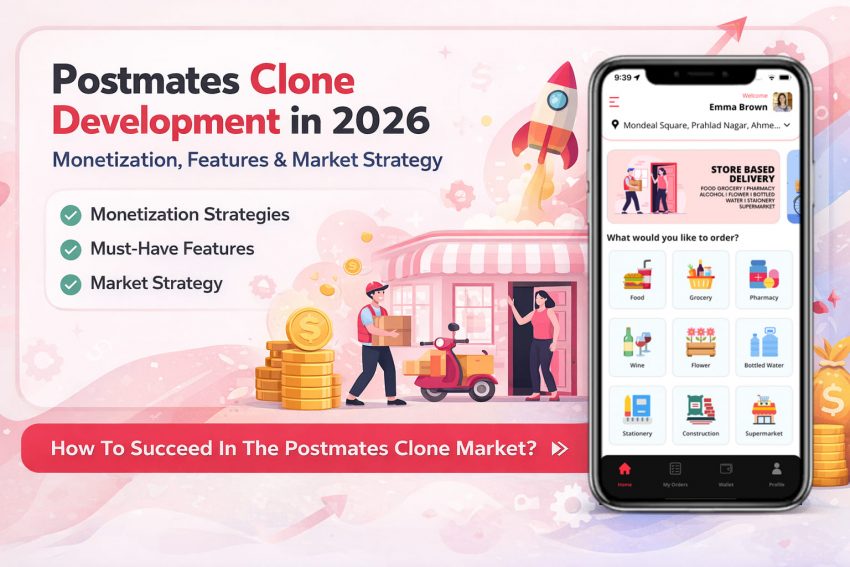
A Postmates Clone is an on-demand multi-delivery app which connects merchants, customers and delivery providers on a single site.
The app lets users place orders at nearby shops or from restaurants. The platform assigns delivery partners to pick up orders and deliver the items to the customer.
Postmates Clone is a Postmates Clone model works as an open-ended marketplace that integrates demand, supply and logistics.
Its success method depends on the smooth co-ordination between vendors, customers, as well as delivery companies.
How does a Postmates Clone App Perform?
Understanding the way in which things work can help companies develop the platform in a way that is efficient. The entire process is usually followed an organized flow.
Step 1: The Customer Places the Order
Customers search for the menus of restaurants or pharmacies, supermarkets or shops for retail nearby. They choose items and add them to their cart, select a delivery location, and then complete the payment by using payment options available.
The app provides delivery times estimates as well as order details clearly, which helps customers take rapid choices.
Step 2: accepts and prepares the Order
After the order has been placed the order is immediately sent to the merchant’s dashboard. The merchant then reviews the order and then begins to prepare.
The system permits merchants to modify order status, for example acceptance of the order, preparation for pickup, or ready to pick up.
This is crucial since the time spent preparing directly affects the effectiveness of delivery.
Step 3: Assignment of Delivery Partner
The platform assigns nearby delivery providers using intelligent algorithms. Delivery partners are notified of orders and are able to accept delivery requests.
Once the order is accepted, delivery partners go to the location of the merchant to pick up the order and then begin delivery towards the address of the customer.
Step 4: real-time tracking and notifications
Customers can monitor their orders live via GPS tracking. The application will send out notification for order confirmation pickup, delivery, and confirmation notifications.
The ability to track real-time builds trust with customers and eliminates any confusion when delivering.
Step 5: Payment and Order Completion Settlement
When delivery is completed, the user is shown an invoice and as per the invoice, money is to be paid. A user can select a preferred mode of payment like Cash, Card, or In-App Wallet.
Essential Features for a Postmates Clone App
A successful delivery platform requires careful feature-based planning. In addition, a heavy load of unneeded features could increase costs of development and decrease the usability.
Customer App Features
- Customers are the main customers for the app. The app must offer an easy and smooth ordering experience.
- Easy to search for products and browse through them
- Integration of multiple payment gateways
- Tracking live orders
- The history of your order and Reordering
- Review and rating system
- Estimated delivery time display
- Push notification and updates to orders
Merchant App Features
Merchants are suppliers. Their dashboard must permit them to easily manage their operations.
- Order management dashboard
- Management of menus and products
- Tracking of inventory
- Reports on earnings and sales
- Working hours and availability control
Delivery Partner App features
Delivery partners are responsible for the logistics functions on the system. Their application must be effective and simple to use when managing the delivery process.
- Delivery Request Alerts
- Route navigation assistance
- Updates on delivery status
- Performance tracking and earnings
- Delivery confirmation
Admin Panel Features
The admin panel is responsible for the whole marketplace. It oversees operations, analytics, as well as revenue setting.
- Management of the user and vendor
- Commission and price control
- Tracking of settlement and payment
- Management of discount and promotion
- Data analytics and monitoring of performance
The Revenue Model in an app cloned from Postmates
A Postmates Clone generates revenue through various revenue streams. Utilizing a variety of sources of income helps to ensure stability in the business.
Commission from Merchants
This is the principal source of revenue. The platform gives merchants a commission for every purchase made via the application.
Commission rates are usually based on agreements between businesses, the place of business, and volume of orders.
Deliver Charges for Customers
Customers pay delivery charges according to size, distance or based on time. This helps to manage the logistics and delivery costs of our partners.
Surge Pricing
During times of high demand or other special events the platforms will increase their delivery costs with flexible pricing methods. This can help balance supply and demand.
Plan of Subscription for Merchants
Certain platforms offer monthly subscriptions for merchants. They may offer reduced commissions, promotions or increased visibility.
Advertising and Featured Listings
Merchants may pay to promote their websites or be in the upper ranks of results for search. This creates additional advertising revenue.
White-Label Vs Custom Development for Postmates Clone
Selecting the appropriate development method directly impacts launch speed costs, scalability, and cost.
White-Label Postmates Clone
White-label services provide pre-made delivery platforms that have the essential features already built-in.
They assist businesses in launching quicker, lower the risk of developing, and reduce cost of investment. White-label applications are ideal for businesses that are just starting out or trying new markets.
Custom Postmates Clone Development
Custom development lets businesses develop fully customized delivery platforms that have unique workflows and sophisticated features.
While custom applications offer flexibility however, they also require a higher level of investments, a longer development time and ongoing technical support.
Businesses typically choose custom-designed development when they require an enviable differentiation or a large-scale expansion.
Operational Challenges of Running a Postmates Clone
Technology alone is not a guarantee of successful operations. Real-time management is equally crucial.
The focus of businesses must be on:
- The process of identifying and managing delivery partners
- Merchant Onboarding and Training
- Support for customers and handling disputes
- Maintaining efficiency in delivery and accuracy of orders
- Preventing fraud and coordinating the process of refunds
Operational efficiency plays a significant part in the long-term success of the Postmates clone.
The business model of the Postmates Clone Model is expanding
The rapid growth of delivery on demand is driven by the convenience of customers and the growing use of digital technology. Multi-service delivery platforms decrease dependence on physical store visits, and offer faster access to services.
Businesses gain from greater customers’ reach, a digital brand recognition and the ability to scale logistics operations.
The model also permits expansion to multiple service categories, including groceries delivery and food deliveries pharmacy delivery and retail logistics.
The Final Words
Postmates Clone apps are changing the way delivery marketplaces work. They integrate logistics, technology and marketplace management into a single, integrated ecosystem.
However, success is contingent on a well-planned strategy and balance between features, operational efficiency, and long-term revenue strategies.
Businesses that know the structures, monetization techniques and operational issues can develop successful delivery platforms. The launch of a scalable and user-friendly system allows businesses to adjust to changing market demands and grow over time in the delivery on demand industry.